
January 31st
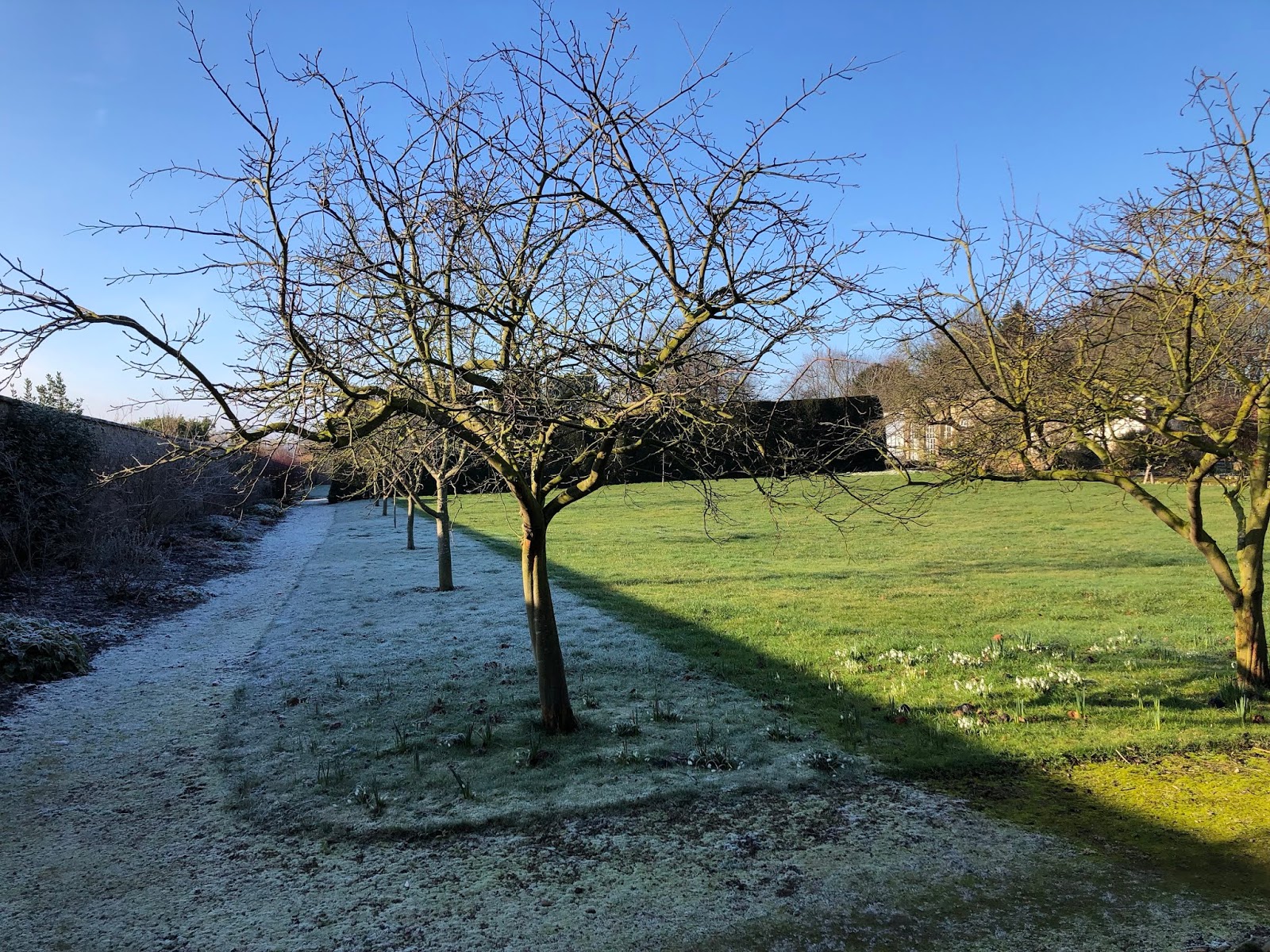
-7.5 Celsius as I passed Nunwick on the way to Norton Conyers. It is the morning of the 31st of January and the coldest night of the season has been endured across the country. The bitter temperatures have bitten throughout much of the month, but the January weather concluded with a numbing vengeance. I walked around the outside of the gardens - senses heightened with the sub-zero temperatures amplifying the eerie silence. Every leaf, twig and blade of grass fixed and fragile in a coarse, crisp shell.
 |
| Frosted Garden Gates, 31st January 2019 |

 |
 |
| 8.30am |
 |
| 1.15pm |
January 3rd
The year had started without frost. Giles and I began 2019 by removing the remainder of the apple tree Malus 'Beauty of Bath' which had been cut down before Christmas. Snowdrops (Galanthus) were beginning to emerge around the tree trunk, and these were lifted before digging up the earth. With axe and chainsaw, thick roots were cut. With rope attached, the tractor was used to pull and twist it out of the earth.


The chainsaw was used once again by Giles and the trunk broken into logs. The earth was replaced - extra compost added and Snowdrops carefully replanted. The job was completed - leaving barely any trace of the 50-year-old tree which once stood. The 'Egremont Russet' planted in close proximity now had space to grow and flourish.
Into the Woods
Next - into the woods. The initial stretch of the pathway was cleared, and habitat piles tidied and consolidated. We then ambled towards the lake, with tools in hand. The area surrounding the lake had been untended for years and it would be a significant undertaking to cut back foliage and retrieve fallen trees from the water. We would spend much of our January days working by the lake.
Starting on the south bank, overhanging branches, brambles and bamboo were cut back, gradually revealing an enhanced view across the lake. I was then employed to cut climbing Ivy (Hedera Helix) on trees to prevent them from being weighed down. I remarked at the woody stalks of the Ivy - some of which were thick enough to be small trees themselves.
 |
| Ivy (Hedera Helix) |
 |
| Luxury A Chestnut Gelding Died 18th July 1918 Aged 16 Years A Celebrated Hunter & Jumper First in the Kings Cup at Olympia 1907 & 1908 Malise Graham |
The Emergence of Life
As the month progressed, subtle glimmers of colour emerged. Most prominently, vibrant strands of lemon and lime sprung from a beautiful Witch Hazel (Hamemelis) to the east of the Orangery. The Hamemelis has a sense of gentle, graceful movement about it - the flowing flowers like the tentacles of a sea anemone. In the dull January light, the Witch Hazel seems to emit its own source of light and bears a delicate scent which belies the season.
 |
Witch Hazel (Hamamelis)
|
But, the reality is that new life is all around us even at the dullest, darkest time of year. Knowing where to look for it is the key. As we walked towards the western garden door, Beth spotted a Hepatica in the undergrowth - it is a small, violet flower of the buttercup family. There is something very special about these small glimmers of fresh colour - a clear display of thriving life and a promise of new life to come.
 |
| Hepatica |
Lakeside
The lakeside clear-up continued. A Willow (Salix) lay in the water - parts completely submerged and sitting in thick mud. Removing it was a real challenge. Loppers were used to remove branches, before a rope was tied. The tractor was then employed to wrench the tree out of the lake. But there was not enough room for manoeuvre and insufficient leverage; I drove the tractor around the perimeter of the lake and into an adjoining field, stopping behind my previous location.
The tractor wheels slipped and struggled to gain traction as it heaved, and Giles climbed onto the trailer for extra ballast! And after moving onto fresh ground the remainder of the tree emerged from the water. The mud in which it had been buried was very smelly; moving it into habitat piles was an unpleasant business!


The snowdrops quickly grew and filled out throughout the month - the budding flowers gradually appearing plump and heavy. They are a welcome sight across the estate, adding patches of winter joy to the barren earth.
Towards the end of the month, we made our way down the lane to Keepers Cottage. Earlier in the month I had ventured in this direction before starting work; I had seen six herons in one field and four roe deer in another - all at the same time!
Work was needed in the garden of the Keepers Cottage, and foliage needed clearing. Derek, Emma and I had the unenviable task of removing a very hardy Philadelphus (Mock Orange), which was obscuring the view from the kitchen. The Philadelphus grows small bowl-shaped white flowers in the summer, with orange centres. However, when removing this shrub from the earth, it was difficult to imagine that it was capable of growing such delicate flowers. It took a great deal of digging, axing and leveraging to remove the base of it from the ground.
With vast quantities of Ivy removed from brickwork, and last-years growth cut back, we left the Keepers Cottage. Giles and I would return on the next working day to remove an aging conifer and unhealthy plum tree (which was also obstructing a window). Both of these were easily removed with spade and tractor.
We were all exasperated with Ivy towards the end of the month; cutting it back from walls and trees had kept us occupied for days around the lake and in the wider estate. We spent much time clearing in the woodland to the north of the house and at Wath Lodge which is 3/4 of a mile away. But this is necessary to prevent it from 'taking over' and causing damage.
January 2019 - a cold, yet physical and incredibly satisfying month. It was a pleasant surprise to see the subtle beauty in nature at this time of year, but also a delight to enjoy the clean, glimmering frosts and low, rolling mists which provided atmospheric backdrops. However, it was also a month in which I witnessed some of the most dramatic, beautiful skies I have ever seen - a selection of which I now end with.


 |
| Willow (Saxis) |

The lake was starting to reveal itself and its true beauty. As the month progressed, bright blue skies created stunning reflections in the water.


In mid-January, Giles cut up a recently felled cherry tree and this was transported to the woodyard using the dumper truck - a huge undertaking, which unfortunately took its toll on the old machine. A section of the bodywork came loose, which required welding. But once Giles had attended to it, the dumper truck continued to fill the woodyard throughout the month, and the last day of January consisted of felling and logging an established Ash tree (Fraxinus).
 |
| Hopeful Plum at lunchtime |
 |
| Hopeful Shandy at lunchtime |
Snowdrops
The snowdrops quickly grew and filled out throughout the month - the budding flowers gradually appearing plump and heavy. They are a welcome sight across the estate, adding patches of winter joy to the barren earth.
 |
| Snowdrops (Galanthus) |
Keepers Cottage
Towards the end of the month, we made our way down the lane to Keepers Cottage. Earlier in the month I had ventured in this direction before starting work; I had seen six herons in one field and four roe deer in another - all at the same time!
Work was needed in the garden of the Keepers Cottage, and foliage needed clearing. Derek, Emma and I had the unenviable task of removing a very hardy Philadelphus (Mock Orange), which was obscuring the view from the kitchen. The Philadelphus grows small bowl-shaped white flowers in the summer, with orange centres. However, when removing this shrub from the earth, it was difficult to imagine that it was capable of growing such delicate flowers. It took a great deal of digging, axing and leveraging to remove the base of it from the ground.
 |
| Derek attacking the remains of the Philadelphus |
 |
| Cold Shandy huddling into one of the gardener's lunches to keep warm!! |
Ivy
We were all exasperated with Ivy towards the end of the month; cutting it back from walls and trees had kept us occupied for days around the lake and in the wider estate. We spent much time clearing in the woodland to the north of the house and at Wath Lodge which is 3/4 of a mile away. But this is necessary to prevent it from 'taking over' and causing damage.
January
January 2019 - a cold, yet physical and incredibly satisfying month. It was a pleasant surprise to see the subtle beauty in nature at this time of year, but also a delight to enjoy the clean, glimmering frosts and low, rolling mists which provided atmospheric backdrops. However, it was also a month in which I witnessed some of the most dramatic, beautiful skies I have ever seen - a selection of which I now end with.


