Sunday, 30 December 2018

Christmas at Norton Conyers


Festive Shandy

And so the end of the year approached. Days were bookended by darkness, and available working hours shortened.

Frost was regularly seen on the grass in the mornings, and sharp, crisp and cleansing air was refreshing - or biting - depending on the number of layers worn. Damp earth was a constant feature.

But echoes of summer were still on display - the season's growth provided plenty of work over the subsequent weeks.

*

Mid November 

Weeds and plant growth in the round garden were cleared, before turning over the earth and mulching. Giles handed round a fallen 'bletted' Medlar fruit - it was much like a fig in both taste and texture. Bletted fruits are 'overripe' and are in the early stages of decay - the starches have converted to sugar. Although medlars are not commonly found nowadays, they were widely cultivated in medieval times - they were popular because they can be stored for a long time after picking - useful at a time when food was very difficult to preserve. Medlars can only be eaten raw when bletted. However, the ripe fruits were picked for making jelly, which is available to purchase in the gardens. 


Medlar Trees
*

A greyscale colour scheme loomed over a cold Norton Conyers the next working day. Work in the round garden was to continue, with shrubs to be pruned. The Elder (sambucae) in demanded particular time and attention. Saws and loppers were used to maintain the shrub's shape and structure - sidewards growth was cut, leaving taller, vertical growth.

Sambucae (Elder)
The dumper truck was used to transfer the mass of branches to the woods, and it was employed for the rest of the day tidying the south border.
*

I wandered towards 'The Keepers Cottage' before work started in late November. Having travelled in the dark, a clear, atmospheric morning quickly revealed itself as I walked - salmon-tinted clouds and an almost egg-shaped moon still suspended in the sky. A golden streak of light started to expand over the fields. And - although cold, the bright, dry weather provided a pleasant working environment for the rest of the day.

Towards The Keepers Cottage

We worked on clearing the garden's main border - a significant undertaking, with masses of growth removed. However, with nearly a full quota of gardeners and volunteers on hand, this work was completed quickly.

Clearing the borders

*

The orangery borders were cleared, and Rosa Floribunda Iceberg (a beautiful white rose) were pruned on the last working day in November. Drizzle was a constant feature, but a brief spell of storm-like weather has us sheltering for cover in the orangery. 

Heavy rain briefly stops play

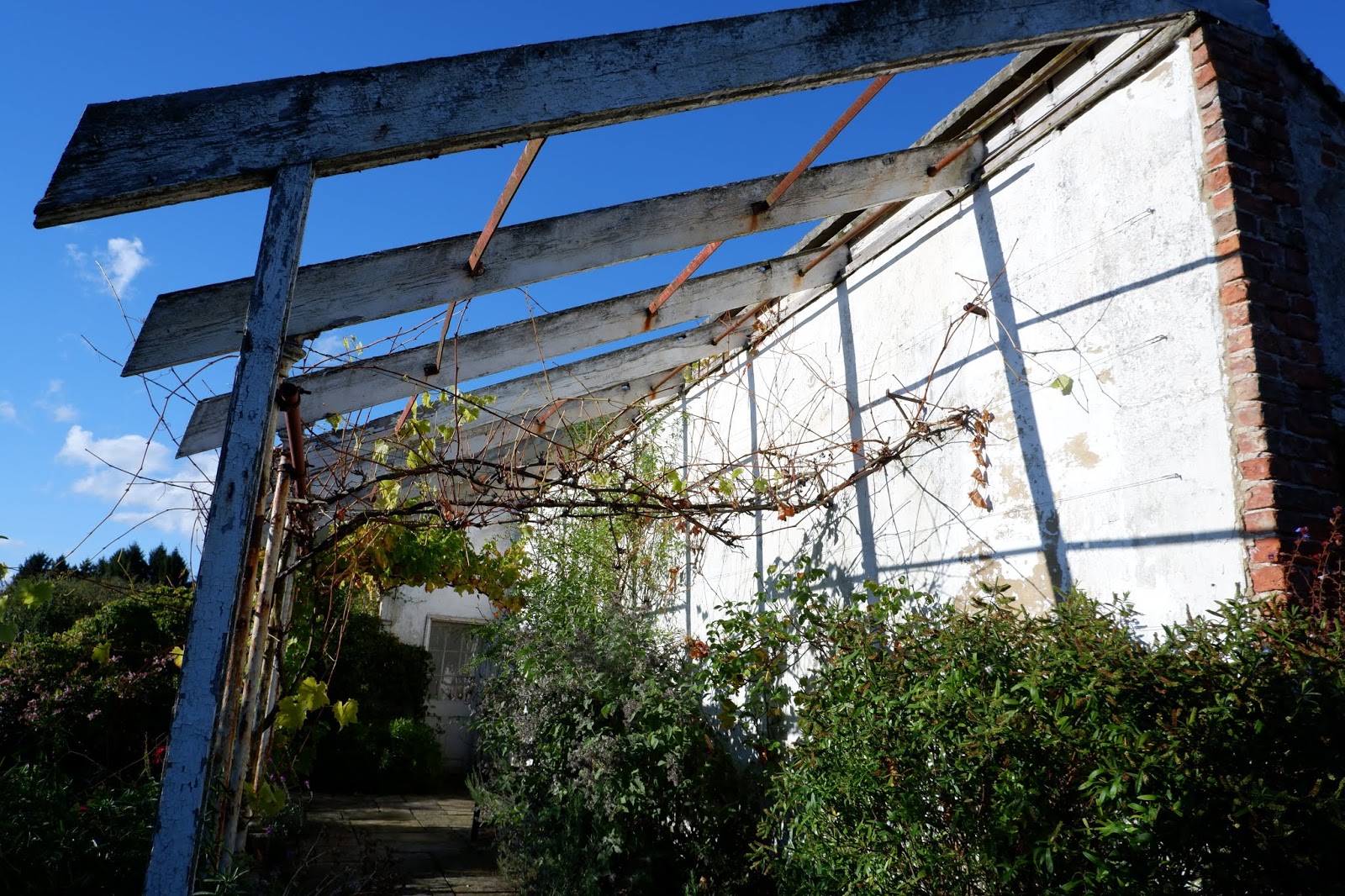
Having cleared the border, I noticed that the bottom of the Vine House wall featured arches. Giles explained that these were to allow the strong, woody vine roots to grow without damaging the wall.

Arches in the vine wall

The weather improved, and a robin followed us around the garden. It appeared suddenly and boldly - often within arms reach - and seemed to study our work.


*

Clearing borders would go on for another two days. It neatened the garden - putting it to bed for the year.  The compost bays were once again full of organic matter.

The cleared main border 


Contrasting weather on 3rd December


*

Into mid-December now, and Giles wanted three rows of gooseberry plants to be removed. They were to be replaced with Jostaberry (Ribes x nidigrolaria) (a gooseberry / blackcurrant hybrid) and Worcesterberry (Ribes divaricatum) plants. "They are spikier plants and have smaller fruits!". Giles said - knowing full well that he wouldn't be the person picking or pruning them! "The fruits are sweeter and we want to promote as many different varieties as we can." 

The existing gooseberry plants were removed quickly and disposed of in the woods. Holes were dug for the new plants and mulch added. 

After lunch, Plum and Shandy watched on from a sunny spot as we went to the round garden to replace tired roses Rosa 'Buff Beauty' - a beautiful creamy orange rose. Flowering had been in decline for the last few seasons, and the scent - or lack of - was disappointing. 

Dogs enjoying the winter sunshine

The roses were unearthed and 18" x 18" holes dug - surrounding plants were temporarily removed in the process. This earth was moved to the vegetable garden. A solution of one part Jeyes fluid to four parts water was poured into the holes. Both of these steps reduced the risk of any disease from the previous plants being passed on to the new roses. A layer of mulch was then added before the new young replacements planted.

*

Another day, and a walk through the woods and to the lake beckoned. Trees were bare and the view over the lake was clear - this was in stark contrast to the green and leafy surrounds in July which completely obscured the view.

An unobscured view across the lake

Today I was struck by the beauty and surprise within nature - even in decay. I had watched the stunning Physalis alkekengi - more commonly known as the Chinese Lantern - grow, develop into its perfect orange lantern shape and then begin to decay - losing colour before the fragile papery covering started to break down. But I hadn't been close enough to see the beautiful fruit within, which now revealed itself.
Physalis alkekengi
*

It was time to prune the roses on the north wall and on the wall outside the car park - Rosa 'Madame Alfred Carriere'. During this process, it was important to consider the future shape of the plant before cutting branches. 'Useful' branches were tied in. Plum and Shandy (who was in full festive attire) watched on. 


Shandy cleaning Plum. Plum watching Emma at work


A previous gardeners' mark atop the garden walls 'Ernie 1989'

*

20th December - our last day in the gardens of 2018. And a bit of festive fun for us all - wreath making. Willow was gathered and four stems weaved into a circle before cuttings from the garden were added - eucalyptus, holly, rosehips, fir cones, rosemary, bay leaves... and our wreaths were made! 

Weaving willow


During this time, Giles had cut down a tiring apple tree Malus 'Beauty of Bath'. Alan and I helped load the wood into the dumper truck. A new apple tree Malus 'Egremont Russet' was later planted.

And after lunch, the Christmas party at David's studio in the courtyard. Savoury nibbles (Emma's goats cheese and fig tarts proved popular), homemade cakes (Mrs G's plum cake and Derek's wife's tea loaf were personal favourites), wine and beer were served and a suitably festive, warm atmosphere enjoyed by all. Sir James was here but it was a shame that Lady Halina wasn't able to join us due to being a little under the weather. 

Gardeners, builders, art students and Sir James!

A cosy spot for two tired dog

A charcoal drawing of 'Head Gardener' Shandy

As the party-goers started to leave, the year came to a close. The garden was neatly stripped back. But signs of life were beginning to emerge. 
And with new trees and shrubs planted, the new year brings with it an even greater sense of expectation and excitement.




Friday, 16 November 2018

Misty Mornings - October 2018


A blanket of mist hovered across the landscape as I drove towards Norton Conyers. It is the eighteenth of October - days before the clocks go back - and there is a real nip in the air; the first morning of the season where car de-icer has been required! I arrived early and walked towards the house - the crunch of frosted grass underneath my boots. The adjacent fields were atmospheric as sheep continued to graze - seemingly unperturbed by the cold.

Later, the sky cleared and the gardens were bathed in autumnal sunshine, but for now there was work to be done.

With leaves scattered across the drive and courtyard, a clear-up was required before they had the chance to degrade. Leaf-blower, rake and brush were used to gather, and dumper truck and wheelbarrow to convey them to the compost heap.

Clearing Leaves


*

The lawns had their final trim of 2018 in late October, after which the machinery was given a little maintenance. A pressure washer was used to clean the lawnmowers, tractor and dumper truck to prevent rusting over the winter. Months of grassy build up and mud were removed. Unfortunately my waterproof boots didn't live up to their promise...

By lunchtime I was already saturated. The lack of wellies was a mistake. But - unfortunately for me, there was more pressure washing to be done in the afternoon (the paving outside the house this time!).


Yellowing Pear Tree


Dahlias

With the temperature dropping, it was time for the Dahlias to be cut back in preparation for winter storage. The masses of foliage collected held on to glimmers of their summer shades. After depletion over the summer, the compost heap was quickly filling again.

The following week, each plant was easily forked out of the ground before being placed in a labelled crate. The many different varieties are curiously - often amusingly named - 'Chat Noir', 'Sean C', 'Thomas Edison', 'Bishop of Canterbury'.

The afternoon's work was more challenging; the Dahlias in the top border of the garden are not labelled and are mixed in with other plants. Giles' encyclopaedic plant knowledge was required to help identify each variety.
As I labelled up a Dahlia as 'Murky Eye', I sensed Giles' amusement - it is in fact spelt 'Merckii'.

After a full day digging up Dahlias, the Orangery is once again filled with dozens of crates of them - protected from the chill of winter.


Dahlias


*

Apple Juice

Apple juice continued to be produced throughout October and into early November - a team effort required to produce the necessary three barrels in a day.
Each batch is a completely unique combination of apple varieties, and so each bottle of Norton Conyers apple juice has its own subtly delicious flavour. 


*

The compost heaps rapidly filled with cuttings from this years' growth. 

But the woody stems from the berry plot were taken into the woods to add to habitat piles.

Redcurrants before pruning


On my first day at Norton Conyers, Giles and I installed wooden supports for new plants in the berry plot. But now, some of the older supports - installed by Giles in 1995 - had given way, and so it was time to replace them.

Installing new supports

*


It is nearly one month since the first paragraph of this post was written - the fifteenth of November. This time mist overwhelmed the atmosphere on my morning commute. And the temperature was bitter. But, as has become a pattern for the time of year, the sun came out unexpectedly and the temperature rose to give a spring-like feel to this Autumnal air. I wonder for how long we will continue to be pleasantly surprised by the weather?


Sunday, 14 October 2018

Pressing On! September 2018


Admittedly, I had been waiting for this moment for some time. But the reality was a little daunting. The 1960s dumper truck would be under my command. The machine is battered, but still sturdy and reliable after decades of service. Giles started the machine, and I drove it towards the woods.

It took a little while to get used to this old engine - the temperamental gearstick, the knack to starting the machine, getting to grips with the (sometimes erratic!) handling - but the feeling when driving it was of liberation and real excitement; this was the dream of my 5 year old self!

Past the house, the pet graveyard and through the meandering woodland, I stopped the machine at the bottom of the slope next to the Ice House.


The Ash tree which had grown atop the Ice House had been felled the previous week. We cleared the leafy debris - building habitat piles, and Giles used his chainsaw to break up the trunk and larger branches. Plum watched on - sitting proudly on the tree stump.


Huge, heavy logs were rolled down the hill and loaded into the dumper truck. I would drive four loads to the wood store on this day, with more to be transferred at a later date. But the Ice House was now ready for restoration. 


The newly, lovingly-restored Ice House


*

The plum trees needed their annual maintenance. After some pruning, we looked for the right growth to train upwards and outwards - tying the fresh growth against the wall with tar twine. The trees gave a good crop this year, despite the neighbouring apple trees which tower above them. This process will promote healthy growth next year.


*

The remarkable weather this year provided ideal growing conditions for the grapes outside the Orangery - Gargarin Blue. The fruits were harvested in their frosted night-blue bunches, and processed; Giles had brought juicing equipment. The grapes were pulped and then pressed, and a small batch of rich, fragrant juice was made.


*

Juicing continued the following week - albeit with a different kind of fruit! Plum and Shandy watched on as different varieties of fallen apples were collected from around the garden. Much of the morning was spent collecting the fruits, and eight or nine full crates were ready for pressing.


The apples were washed, quartered and processed. Two and a half barrels of juice were filled and ready for pasteurisation.

And over the following days, more apples would be collected and stored in the Orangery for future juicing; the smell was intoxicating.

*

The paeony beds were now clear of their dead summer growth, and we had forked them over in their entirety the previous week. Compost was even distributed over this patch; a process that is to be repeated every four to five years.


*

Whereas juicing apples were windfalls, ladders were needed to fetch apples suitable for storage. Ladders were climbed, and the best apples were picked and passed to a colleague on the ground. The apple store was prepared and the apples were carefully placed - small gaps between - in their varieties. And pumpkins - which had been grown on the compost heaps, and 'cured' in the sun - filled the shelves above.


Autumn really is here.


Sunday, 16 September 2018

Autumn Leaves - August 2018

'Discovery' Apples

Autumn crept up on us this year. The transition seemed fast and definite after a summer that seemed at times to be endless.

I first noticed the onset of autumn walking on the Stray in Harrogate in mid August, with the first expiring leaves laying lifelessly on the pavement. Although the temperature remained fairly mild in the subsequent days, the change in the weather following this came rapidly and unexpectedly. 

However, more subtle signs of the change in the seasons were already present in nature, with beautiful Cyclamen Hederifolium growing outside Norton Conyers House, apples falling around the gardens and autumn raspberries ripening.

Cyclamen Hederifolium

Pony Paddock Transformation

The most notable change in the weather came on September 3rd, which started off mild and bright. David, Giles and I were busy making the preparations for a new car park in the disused pony paddock. A digger and steamroller had been hired for this purpose, and we spent the day digging up grass and sandy earthy. 

The shape of a road and pathway was visible by lunchtime; in the afternoon, David and I picked up rakes to spread the Yorkshire stone gravel that Giles moved around with the digger and dumper.

And the clouds descended; rain came and persisted. Waterproof jackets were donned by David and I; Giles sat happily dry in the digger, poking regular fun - 'Is it raining out there?!' This was the first time the sky had truly been darkened, and I now knew summer really was over.

The digger was employed for another two days, and after another delivery of stone chipping and much raking, the car park was completed - ready for a wedding on the 15th September. However, grass seed still needs spreading around the perimeter and Giles aims to transform the adjoining area into a wildflower meadow.

The disused Pony Paddock
The path to the new car park
Before
David and Giles at work digging out the car park
After - grass seed yet to scatter!
Autumn Crops

The last of the runner beans and french beans were gathered towards the end of August, and a plentiful crop of sweetcorn was harvested. This year's growing conditions have favoured the growth of very healthy crops - and grapes, plums, damsons and tomatoes have been amongst other recent success stories.

Onions now hang in the Apple store and pumpkins - grown on the compost heaps - sit in a line on a wall. These images are powerful reminders of the time of year - of wholesome, home-cooked food and cooler, shorter days.
Onions hanging in the Apple Store


Pumpkins lining the walls

Wedding Preparations

Mowing continued on a weekly basis throughout August and into September in preparation for the wedding. Weeding and tidying were prioritised in the weeks leading up to the wedding as a result, with the Yew hedges (Taxus Baccata) trimmed by David and Giles.
The garden remained full of life, colour and structural interest at the time of the wedding.


The erection of the wedding marquee


Ready for the big day!

Norton Conyers Supporting WFGA

Rebecca (Bex) Moore-Yelland works in the gardens at Norton Conyers through the WRAGS (Work and Retrain as a Gardener) Scheme. The scheme is run by WFGA (Womens Farm and Garden Association) for which Rebecca is the regional manager for Yorkshire.

Norton Conyers was pleased to be able to support Rebecca's work for the WFGA at The Harrogate Autumn Flower Show in mid September. The beautiful garden created by the WFGA won a Gold Award.

WFGA's Garden at The Harrogate Autumn Flower Show explored 'Pushing the boundaries for access to horticulture'


Into Autumn

As the less favourable weather starts to descend, thoughts now turn to juicing apples, cutting back the summer growth, tidying and making preparations for next year. I wonder what Giles has in store for us next?!


Friday, 17 August 2018

The Earth's Bounty - Norton Conyers, July 2018


Varied Fortunes in Adverse Conditions

The parched land at Norton Conyers was finally relieved in mid July. Memories of the summer in 1976 had been very much alive in the public conscience, as records were broken week after week. Unfortunately for the gardener, the weather cannot be changed; adverse conditions can stifle and overwhelm. The lawns yellowed, and whilst some plants struggled between waterings, others flourished despite the arid soil:

Passiflora caerulea (Blue passionflower)
Cherry and apple trees were also resolute and unmoved by the lack of rain; both developed healthy fruit during this period.


The Relief of Rain

On a day in which Alan had spent most of the morning watering the vegetable garden, the rain finally came! He had left for home half an hour previously, and I couldn't help but imagine his exasperation at the sheer irony of this. However, the downpour was brief, so the work wasn't in vain after all. However, it was enough to refresh the still and stagnant air.

This was to be the end of the drought; intermittent spells of rain followed over the coming days, with the occasional storm. And remarkable things started to happen...

*

The speed of the grass' recovery was something to behold. Mowing had been abandoned for six weeks; the small amount of scruffy growth was left to prevent further damage. Colour quickly started to return to the lawns, and a fortnight after the first rain, it was ready for cutting again. Usual working arrangements fell back into place, with strimming and mowing being completed every Thursday.

However, the success of the vegetable garden was the biggest surprise for me. Whilst the vegetables were religiously and thoroughly soaked during the heatwave, I thought the enduring heat may stymie their success. But a bumper crop prevailed - carrots, cauliflowers, onions, peas and beans to name just a few good crops. 

A barrow full of marrows!! 
The speed of growth in the garden after the drought has been difficult to keep up with. A 'barrow full of marrows' was harvested at the beginning of August - a process to be repeated within two weeks! Similarly, cucumbers growing in the greenhouse were remarkably prolific and fast to grow. 
We have also been blessed with bountiful beetroot - some are now the size of footballs!

The produce at Norton Conyers is well used: it is available to purchase in the orangery and boxes of fruit and vegetables are regularly taken up to the house.

A personal favourite recipe is Gennaro Contaldo's Curly Kale Pizza. It may sound rather suspicious, but it is incredibly tasty, with chilli, garlic, tomatoes, capers, olives and nuts providing the base for the kale topping. Norton Conyers' kale was used, and the pizza was enjoyed in our house on two consecutive evenings!

*

This year, Giles planted a variety of salad potato that he has not grown for 40 years; the 'Pink Fir Apple' is an unusually-shaped heritage potato. Blight had started to attack the foliage of a number of the plants; I was tasked with cutting the affected back to the base. Alan and I were to dig up this variety the following week; I was impressed with the flavour and texture of this heritage crop.

Digging up Pink Fir Apples potatoes


Flourishing Willow

At the beginning of August, Giles asked me to cut back the willow hedge adjacent to the greenhouse; I thought back to one of my first days in the garden in early March, where all of the gardeners were involved in pruning and pollarding the previous years' growth. That same hedge had grown with vigour in the intervening months, and now towered above and impeded the pathways to the side. I was struck by the willow's sheer vim and vigour.

Pollarded Willow in March

The same Willow in August


A Time to Reflect

Months of hard work and patience have been rewarded over recent weeks. Whilst work in the gardens never ends, there is a deep sense of satisfaction gained through successfully growing - and harvesting - the earth's bounty.
It is incredible to think of the development of the gardens - both manmade and natural - since I started working at Norton Conyers in February. 

Kevin Woods builders have been on site over the last few weeks; their work consists of restoration and repair - preserving and respecting the past, with a keen eye on posterity.

And this reflects the work in the gardens too - assisting nature, and building on generations of hard work, whilst seeking new opportunities for development and improvement.

Apple trees in March
August