Monday, 13 May 2019

The Transience of Nature - April 2019


April 1st 2019 - Norton Conyers gardens looked very smart with its newly-laid gravel paths.
Having witnessed the subtle emergence of Spring colours in late February and March, the season was now in full flow - the speed of change accelerating.

The month began with weeding the vegetable garden, and removing the remaining crops from last season. After hours of painstaking work, it was ready for planting - a blank canvas once again.


In the afternoon, Sharron and I attended to the garden's hazel supports - most of which are in the main border. Repairing and strengthening these structures is a painstaking, yet therapeutic task; weaving the branches requires both delicacy and intricacy, but the process also comes with a great deal of satisfaction. Here, I am once again led to draw a comparison with a blank canvas. The hazel supports stand strong and skeletal over winter; in Spring, the 'colouring in' begins as verdant growth emerges from the earth. Over the course of the seasons, the supports are completely overwhelmed by nature, and cannot be seen. They are the bare bones on which many plants in the garden grow.


It was a joy to walk around the gardens at leisure today. Although every example of 'beauty' and 'perfection' quickly shifts, this transience of nature is to be celebrated.

My personal favourite plant at this time of the year is the stunning Crown imperial (Fritillaria imperialis). With its many bright, drooping flowers, and 'crown' of spiky green foliage, this plant brings exotic ecstasy to the borders in which it briefly blooms.
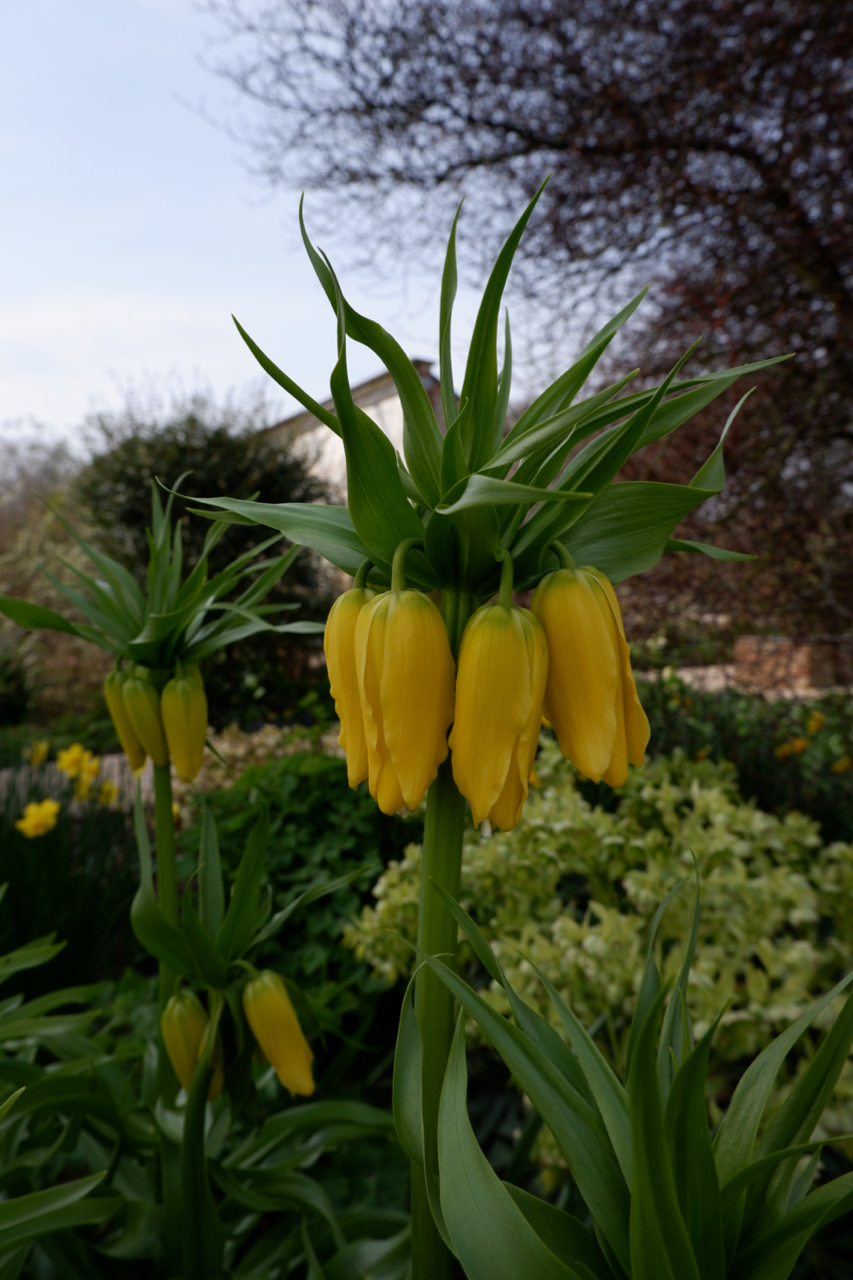

Crown imperial (Fritillaria imperialis)


There is also something special about the humble Primrose (Primula acaulis), which flowers in a most understated fashion. Its gentle beauty and pastel hues provide unexpected charm throughout the garden.


Primrose (Primula acaulis)


Among many other highlights this month were Spring Snowflakes (Leucojum vernum), (which bears a strong resemblance to snowdrops - except the petals are green-tipped and more pointed) and the beautiful white apple blossom.


Spring Snowflakes (Leucojum vernum)


Apple Blossom

*

I was most confused when Giles mentioned the use of a 'Wacker plate'. I wondered what this contraption might be and how it would be used. Either way, I would be using it.

And so the (extremely heavy) machine was lifted onto the ground outside the entrance to the garden. It had the appearance of a lawnmower, but with a completely flat base. A Wacker plate!


Wacker Plate!


Throughout the course of the day, Bex and I used this machine to flatten the path by compacting the gravel. It was a slow and noisy process, but the result provided a smoother, more serviceable surface.


*

With a wedding in the gardens in early May, mowing would be a regular activity. The expanse of lawn on the east side of the garden would require mowing by hand and the cuttings would have to be collected! A time-consuming business, but extremely satisfying.


*

As some flowers (including daffodils, Spring Snowflakes and Crown imperials) withered, so fresh life continued to emerge; mute purple hostas broke through dead earth; peony stems reached towards the sky in rigid exultation; fern fronds unfurled their verdant coils.


Hostas


Peonies


Fern


Sweet William (Dianthus barbatus) had also begun to emerge. Being a cut flower, it is important to provide support at an early stage to ensure strong, upright stems. To this end, Alyson and I assembled a frame of Willow. I always look forward to the Sweet William's dainty 'fireworks' of colour.


Sweet William (Dianthus barbatus) supports


*

April also saw the colour of the irises begin to emerge; the plants tease with their deep purple and yellow buds. We are expecting great things from the iris borders this year; having been divided two years ago, the flowers are expected to be at their best this year!


Iris Border


And with Dahlias now potted up, there is much to look forward to in the gardens. But, if the last month has taught me anything, it is to savour every moment, and to enjoy and appreciate every flower; without consciously appreciating the garden at each stage of its development, one always runs the risk of missing out on something truly special. Therefore, it's so important to 'keep up' with nature by paying close attention to its cycles of growth, fruition and death.


Sunday, 31 March 2019

Into March at Norton Conyers - 2019


This month began without ceremony. A colourless sky enveloped the cool atmosphere on the morning of the 4th of March. But walking around the gardens, further glimmers of colour were beginning to emerge. The peach trees - with their soft pink and vibrant magenta blossom - were a particular highlight, offering a stark and uplifting contrast to their dull, monotone background.

Peach blossom
But the first task of the month involved no gardening at all for me. The dull skies mirrored the lustreless scrap metal that lay in a heap in the old piggery. Giles and I were to load it into the van to be taken to the scrapyard. Although there was nothing of value amongst the scrap, each piece had a story - a purpose and place on this estate. I considered this as I loaded the van, imagining how each piece would once have been used.

Giles' van was loaded, and it was time for tea. As the van's tyres flattened slightly under the weight of this redundant rust, we all 'guessed the weight' of the metal. Giles promised a 'mystery prize' for the winner - remarking that the last 'mystery prize' he promised remains a mystery to this day...

Guesses ranged from 350 - 600kg. But after Giles and I returned from the scrapyard, it was Sharron who claimed the prize (chocolate buttons) with her on-the-nose estimate of 560kg! 

Plum and Shandy enjoying the ride to the scrapyard

Back to the garden in the afternoon. The 'bigger picture' of our work is always considered by Giles; every minute at work is carefully considered, and there is always great purpose and planning in all that we do. With this in mind, last summer's drought meant that watering of the garden was a daily necessity. The garden well was quickly depleted, and this presented a problem, because many of the garden taps take water directly from the well, rather than the mains supply. 

I helped Giles to connect the mains supply up with the well, ensuring the easy flow of water around the garden all the year round. On my first day working in the gardens in February 2018, a new tap was introduced into the vegetable garden; this year's work builds on this further as a crucial time-saver over the busy summer months, whilst also ensuring the whole garden is able to thrive all the year round.

Connecting the mains supply with the garden well

One of the many highlights of working at Norton Conyers last year was pollarding the White Willow (Saxis alba). Once again, we went about cutting back the fading golden russet branches. It was incredible to consider the sheer extent of the growth of the trees in that time - long, thick and healthy branches had developed since the last annual pruning.

White Willow (Saxis alba) before pollarding
Pollarding willow is a painstaking, yet therapeutic process, requiring much attention to detail and careful consideration; it is important to leave a few branches of medium thickness to 'weave' back along - training the trees into a striking linear shape.
 

After pollarding

In the afternoon - resourceful as ever - Giles tasked Sharron and myself to repair supports in the main border using some of the willow branches.


Giles often says, 'Rome wasn't built in a day!'. There are so many plans for the future development of the garden. But, as with life, priorities change, and plans evolve. I suppose that's the very essence and nature of gardening and land management - there is never really an 'end goal', because there is never a finishing point; instead the gardener builds on last years' successes; learns from the failures and strives for continuous improvements.

With that in mind, the mammoth task of gravelling the garden paths began this month. And a new wheelbarrow was brought in to help! In some areas, a layer of the existing surface was removed and relocated to 'build up' some of the path surfaces.


The tonnes of gravel arrived, and the paths were gradually transformed - backbreaking work; the gravel has added further brightness and refinement to the garden, whilst providing improved conditions underfoot!

With paths nearing completion and the view across the willow border unimpeded once again, the entire garden had a makeover in this month. To top it off? The first grass cut of the year.
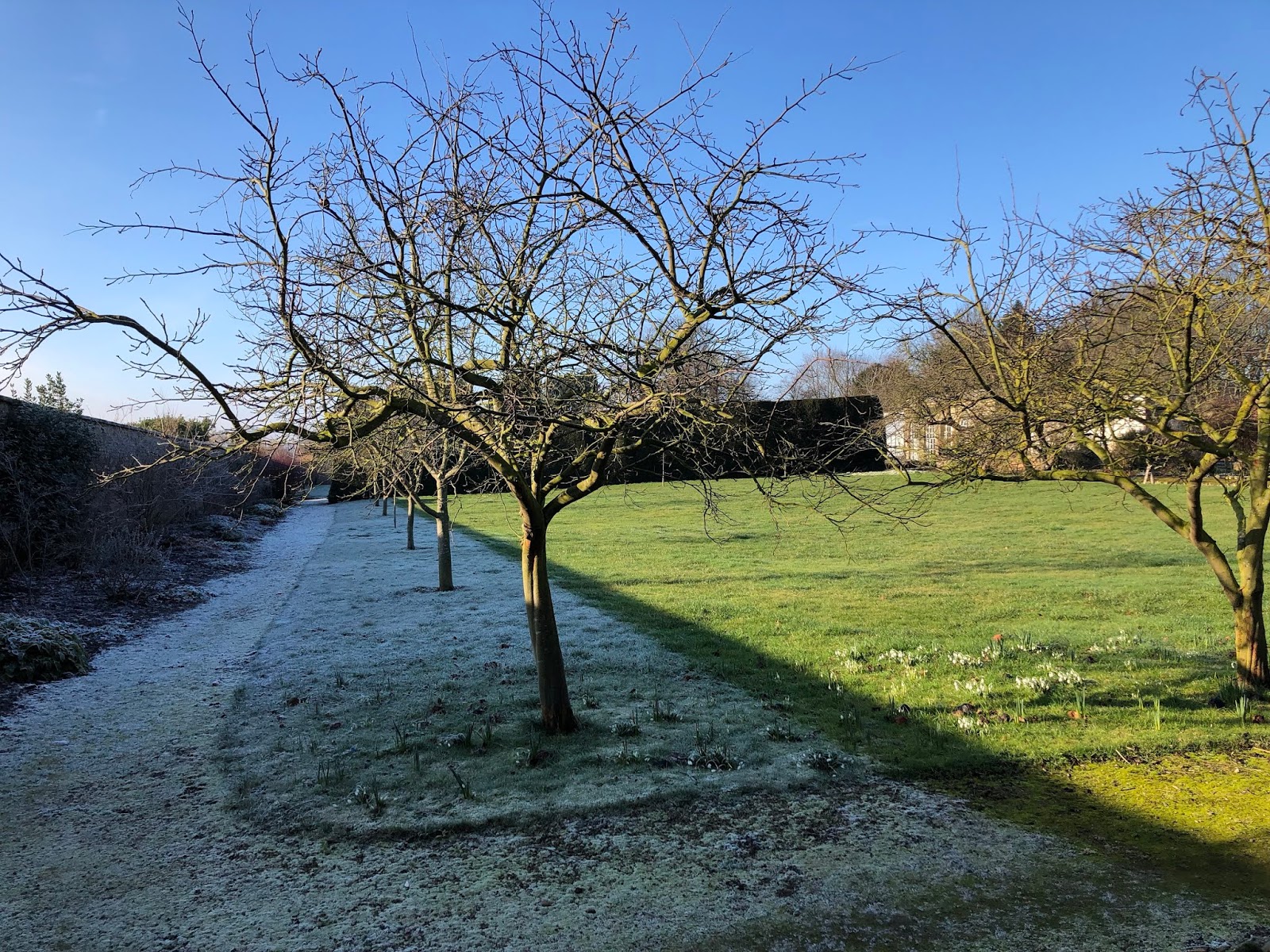
With the previous lawnmower showing some wear and tear, Giles brought in a new machine. As I pushed the mower around the walled gardens, I could almost taste the summer in the air - having completed this task on a weekly basis during the height of last year's season. 

And with the autumn and winter grass growth now cut, the garden once again felt refreshed and primed - ready for the beauty and transformation within the year ahead.


Friday, 1 March 2019

A Year at Norton Conyers - February 2019


And so, this month marked a year working at Norton Conyers for me. I feel very privileged to have the chance to work in this glorious, historic estate - helping to build on the work of previous generations.

Having started this blog on my first day working in the gardens on 19th February 2018,  now is a good opportunity to look back and reflect at how the gardens have evolved in that time, and also how differently the garden grows from year to year.

There was little sense of Spring in the air on my first day last year - in fact, it rained for the entire day! And towards the end of February 2018, the infamous 'Beast from the East' hit, bringing much of the country to a standstill.

This year, it seems we had the worst of the winter cold at the end of January. And with temperatures reaching 18C in parts of the country during February, the weather continues to keep all of us on our toes.

And with warmer temperatures bringing trees into bud, and signs of life beginning to emerge from their winter dormancy, there was certainly the sense that 'Spring sprung' in February this year.

*
Medlar (Mespilus germanica) in bud


The dumper truck was in full use for the duration of this month. It is a well-used asset to the estate and owes nothing after nearly 60 years of service! I used it to transport tonnes of freshly-cut logs from the woods to be seasoned. It also had the purpose of collecting waste metal from around the estate to be recycled.


Whereas usually habitat piles would be built with waste garden material, the volume produced through cutting back shrubs, ivy and brambles meant some of it would have to be burned. We rarely burn material at Norton Conyers, but sometimes it is a necessity. As plant material was cut back between the boundary of the woodland and the car park, and along the south wall of the gardens, I loaded the dumper truck and transported the material to the old tennis courts, where a bonfire was started.

*

Whereas the Snowdrops (Galanthus) had only recently emerged this time last year, their prime had already been enjoyed by the beginning of February 2019. Throughout the month, they would become tired and tinged with brown. But as Snowdrops herald the beginning of Spring, so this meant the gardens would quickly begin to transform with fresh life.

Rhubarb (Rheum) was relocated (and some removed) in bud on 26th February last year; a year to the day, and - in a show of the early onset of Spring - some had already sprouted. 

Rhubarb (Rheum)

*

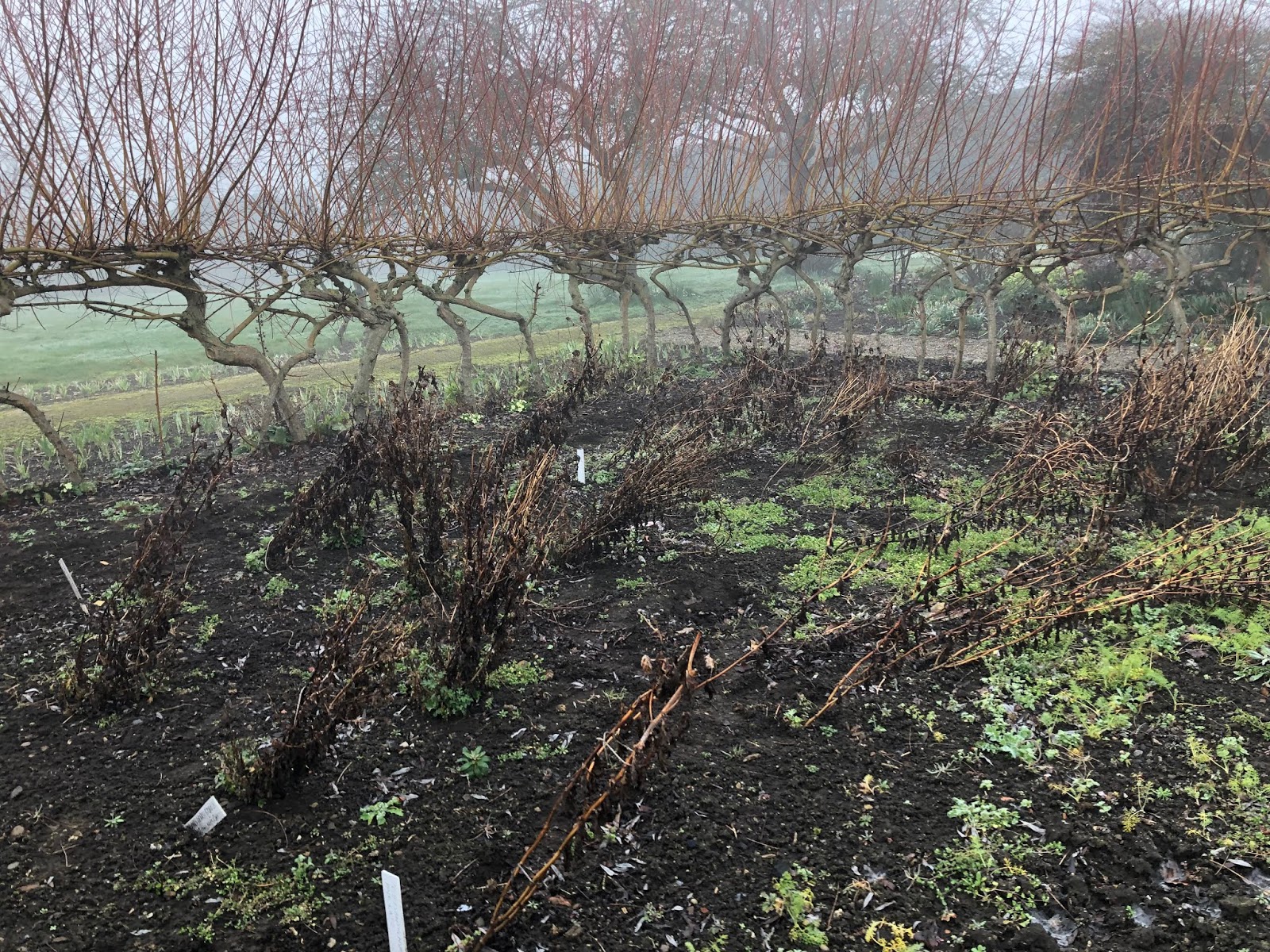
The mist was thick on the morning of the 25th February; after a glorious few weeks of weather, it was a reminder that we were still in February, and winter weather would still make an appearance.

On this morning, I was set the task of digging out the Chrystanthemums within the willow-bordered garden. All withered and in a monotone dull brown, they offered a stark contrast to the varied pastel shades that were enjoyed over the summer. Again - a reminder of the passing of the seasons, and the stark contrasts in colour, texture and light offered in the gardens throughout the year.

Chrysanthemums, Feb 2019

Chrysanthemums, July 2018


Next, it was to the vegetable garden. Bex had strimmed the Manure Grass which had been sown towards the end of 2018. Alan, Bex, Margaret and I turned over the Manure Grass with spades. It is sown as a fast-growing grass, which, when turned back into the earth, breaks down to enrich the earth - it is a natural fertiliser, which also discourages the growth of weeds.

After our morning break, the sun suddenly began to break through the clouds and mist, and the temperature soon began to rise; jackets and jumpers were promptly removed.

And as some of the remaining vegetables were removed from the patch in the afternoon, these milestones in the seasons remind us to look forward to the new growth which will appear over the coming weeks and months.


February ended in glorious sunshine, and as winter dissolves, the cycle of life begins again.


Saturday, 2 February 2019

Lakeside Logging at Norton Conyers - January 2019


January 31st

-7.5 Celsius as I passed Nunwick on the way to Norton Conyers. It is the morning of the 31st of January and the coldest night of the season has been endured across the country. The bitter temperatures have bitten throughout much of the month, but the January weather concluded with a numbing vengeance. I walked around the outside of the gardens - senses heightened with the sub-zero temperatures amplifying the eerie silence. Every leaf, twig and blade of grass fixed and fragile in a coarse, crisp shell.

Frosted Garden Gates, 31st January 2019


8.30am
1.15pm


January 3rd

The year had started without frost. Giles and I began 2019 by removing the remainder of the apple tree Malus 'Beauty of Bath' which had been cut down before ChristmasSnowdrops (Galanthus) were beginning to emerge around the tree trunk, and these were lifted before digging up the earth. With axe and chainsaw, thick roots were cut. With rope attached, the tractor was used to pull and twist it out of the earth.

The chainsaw was used once again by Giles and the trunk broken into logs. The earth was replaced - extra compost added and Snowdrops carefully replanted. The job was completed - leaving barely any trace of the 50-year-old tree which once stood. The 'Egremont Russet' planted in close proximity now had space to grow and flourish.

Into the Woods

Next - into the woods. The initial stretch of the pathway was cleared, and habitat piles tidied and consolidated. We then ambled towards the lake, with tools in hand. The area surrounding the lake had been untended for years and it would be a significant undertaking to cut back foliage and retrieve fallen trees from the water. We would spend much of our January days working by the lake.

Starting on the south bank, overhanging branches, brambles and bamboo were cut back, gradually revealing an enhanced view across the lake. I was then employed to cut climbing Ivy (Hedera Helix) on trees to prevent them from being weighed down. I remarked at the woody stalks of the Ivy - some of which were thick enough to be small trees themselves.


Ivy (Hedera Helix)

As we made our way around the lake, we came across a headstone - for a horse. A small pet cemetery also exists in the woodland near the house and - as I later discovered - across the lake.


Luxury
A Chestnut 
Gelding
Died 18th July 1918
Aged 16 Years
A Celebrated Hunter
& Jumper First in the
Kings Cup at Olympia
1907 & 1908
Malise Graham

The Emergence of Life


As the month progressed, subtle glimmers of colour emerged. Most prominently, vibrant strands of lemon and lime sprung from a beautiful Witch Hazel (Hamemelis) to the east of the Orangery. The Hamemelis has a sense of gentle, graceful movement about it - the flowing flowers like the tentacles of a sea anemone. In the dull January light, the Witch Hazel seems to emit its own source of light and bears a delicate scent which belies the season. 


 Witch Hazel (Hamamelis)
But, the reality is that new life is all around us even at the dullest, darkest time of year. Knowing where to look for it is the key. As we walked towards the western garden door, Beth spotted a Hepatica in the undergrowth - it is a small, violet flower of the buttercup family. There is something very special about these small glimmers of fresh colour - a clear display of thriving life and a promise of new life to come.

Hepatica

Lakeside


The lakeside clear-up continued. A Willow (Salix) lay in the water - parts completely submerged and sitting in thick mud. Removing it was a real challenge. Loppers were used to remove branches, before a rope was tied. The tractor was then employed to wrench the tree out of the lake. But there was not enough room for manoeuvre and insufficient leverage; I drove the tractor around the perimeter of the lake and into an adjoining field, stopping behind my previous location.

The tractor wheels slipped and struggled to gain traction as it heaved, and Giles climbed onto the trailer for extra ballast! And after moving onto fresh ground the remainder of the tree emerged from the water. The mud in which it had been buried was very smelly; moving it into habitat piles was an unpleasant business!
Willow (Saxis)


The lake was starting to reveal itself and its true beauty. As the month progressed, bright blue skies created stunning reflections in the water.


In mid-January, Giles cut up a recently felled cherry tree and this was transported to the woodyard using the dumper truck - a huge undertaking, which unfortunately took its toll on the old machine. A section of the bodywork came loose, which required welding. But once Giles had attended to it, the dumper truck continued to fill the woodyard throughout the month, and the last day of January consisted of felling and logging an established Ash tree (Fraxinus).


Hopeful Plum at lunchtime


Hopeful Shandy at lunchtime


Snowdrops


The snowdrops quickly grew and filled out throughout the month - the budding flowers gradually appearing plump and heavy. They are a welcome sight across the estate, adding patches of winter joy to the barren earth.


Snowdrops (Galanthus)


Keepers Cottage


Towards the end of the month, we made our way down the lane to Keepers Cottage. Earlier in the month I had ventured in this direction before starting work; I had seen six herons in one field and four roe deer in another - all at the same time!

Work was needed in the garden of the Keepers Cottage, and foliage needed clearing. Derek, Emma and I had the unenviable task of removing a very hardy Philadelphus (Mock Orange), which was obscuring the view from the kitchen. The Philadelphus grows small bowl-shaped white flowers in the summer, with orange centres. However, when removing this shrub from the earth, it was difficult to imagine that it was capable of growing such delicate flowers. It took a great deal of digging, axing and leveraging to remove the base of it from the ground.


Derek attacking the remains of the Philadelphus
With vast quantities of Ivy removed from brickwork, and last-years growth cut back, we left the Keepers Cottage. Giles and I would return on the next working day to remove an aging conifer and unhealthy plum tree (which was also obstructing a window). Both of these were easily removed with spade and tractor.


Cold Shandy huddling into one of the gardener's lunches to keep warm!!

Ivy


We were all exasperated with Ivy towards the end of the month; cutting it back from walls and trees had kept us occupied for days around the lake and in the wider estate. We spent much time clearing in the woodland to the north of the house and at Wath Lodge which is 3/4 of a mile away. But this is necessary to prevent it from 'taking over' and causing damage.


January


January 2019 - a cold, yet physical and incredibly satisfying month. It was a pleasant surprise to see the subtle beauty in nature at this time of year, but also a delight to enjoy the clean, glimmering frosts and low, rolling mists which provided atmospheric backdrops. However, it was also a month in which I witnessed some of the most dramatic, beautiful skies I have ever seen - a selection of which I now end with.