Showing posts with label garden. Show all posts

Friday, 1 March 2019

A Year at Norton Conyers - February 2019


And so, this month marked a year working at Norton Conyers for me. I feel very privileged to have the chance to work in this glorious, historic estate - helping to build on the work of previous generations.

Having started this blog on my first day working in the gardens on 19th February 2018,  now is a good opportunity to look back and reflect at how the gardens have evolved in that time, and also how differently the garden grows from year to year.

There was little sense of Spring in the air on my first day last year - in fact, it rained for the entire day! And towards the end of February 2018, the infamous 'Beast from the East' hit, bringing much of the country to a standstill.

This year, it seems we had the worst of the winter cold at the end of January. And with temperatures reaching 18C in parts of the country during February, the weather continues to keep all of us on our toes.

And with warmer temperatures bringing trees into bud, and signs of life beginning to emerge from their winter dormancy, there was certainly the sense that 'Spring sprung' in February this year.

*
Medlar (Mespilus germanica) in bud


The dumper truck was in full use for the duration of this month. It is a well-used asset to the estate and owes nothing after nearly 60 years of service! I used it to transport tonnes of freshly-cut logs from the woods to be seasoned. It also had the purpose of collecting waste metal from around the estate to be recycled.


Whereas usually habitat piles would be built with waste garden material, the volume produced through cutting back shrubs, ivy and brambles meant some of it would have to be burned. We rarely burn material at Norton Conyers, but sometimes it is a necessity. As plant material was cut back between the boundary of the woodland and the car park, and along the south wall of the gardens, I loaded the dumper truck and transported the material to the old tennis courts, where a bonfire was started.

*

Whereas the Snowdrops (Galanthus) had only recently emerged this time last year, their prime had already been enjoyed by the beginning of February 2019. Throughout the month, they would become tired and tinged with brown. But as Snowdrops herald the beginning of Spring, so this meant the gardens would quickly begin to transform with fresh life.

Rhubarb (Rheum) was relocated (and some removed) in bud on 26th February last year; a year to the day, and - in a show of the early onset of Spring - some had already sprouted. 

Rhubarb (Rheum)

*

The mist was thick on the morning of the 25th February; after a glorious few weeks of weather, it was a reminder that we were still in February, and winter weather would still make an appearance.

On this morning, I was set the task of digging out the Chrystanthemums within the willow-bordered garden. All withered and in a monotone dull brown, they offered a stark contrast to the varied pastel shades that were enjoyed over the summer. Again - a reminder of the passing of the seasons, and the stark contrasts in colour, texture and light offered in the gardens throughout the year.
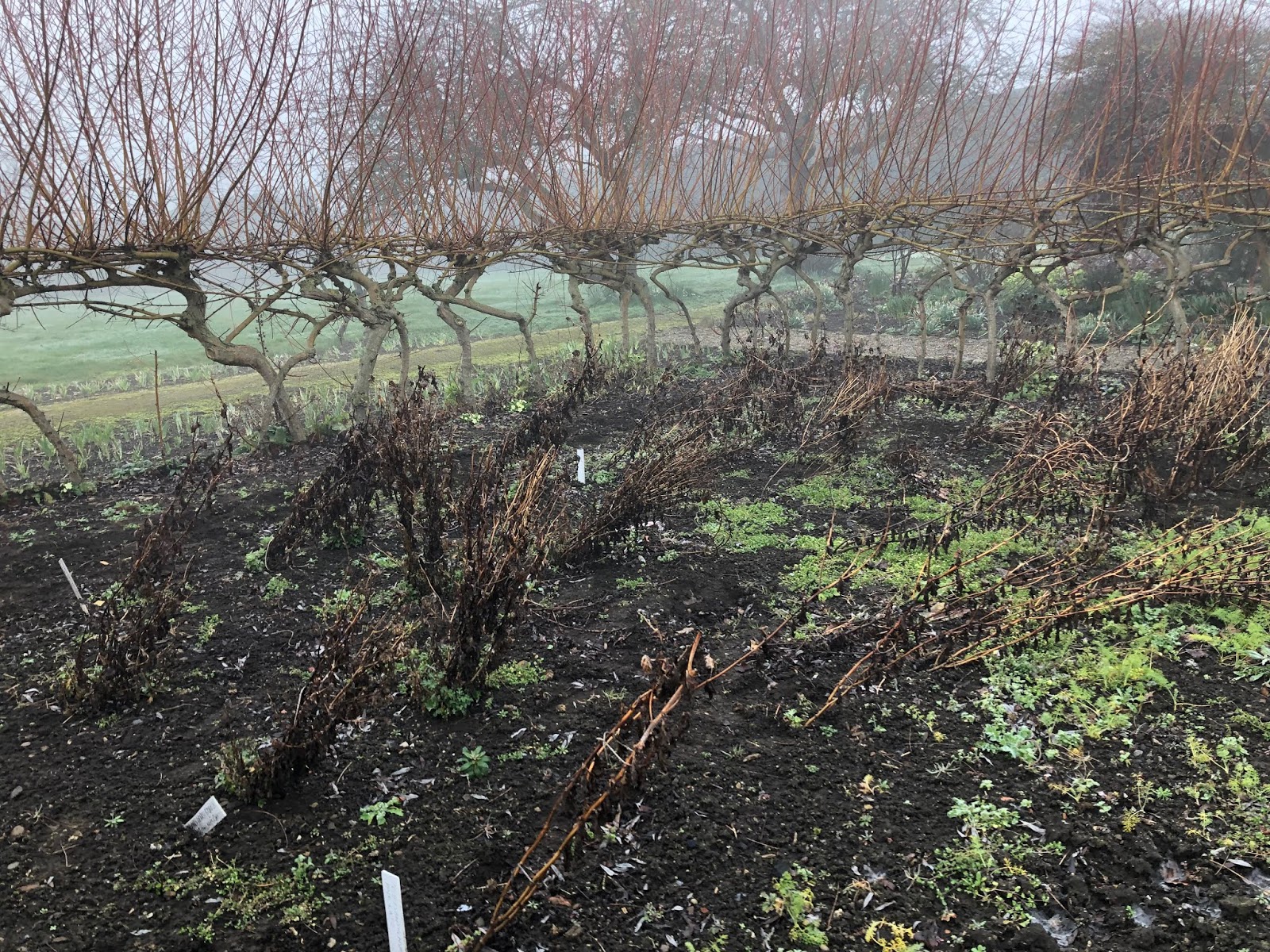
Chrysanthemums, Feb 2019

Chrysanthemums, July 2018


Next, it was to the vegetable garden. Bex had strimmed the Manure Grass which had been sown towards the end of 2018. Alan, Bex, Margaret and I turned over the Manure Grass with spades. It is sown as a fast-growing grass, which, when turned back into the earth, breaks down to enrich the earth - it is a natural fertiliser, which also discourages the growth of weeds.

After our morning break, the sun suddenly began to break through the clouds and mist, and the temperature soon began to rise; jackets and jumpers were promptly removed.

And as some of the remaining vegetables were removed from the patch in the afternoon, these milestones in the seasons remind us to look forward to the new growth which will appear over the coming weeks and months.


February ended in glorious sunshine, and as winter dissolves, the cycle of life begins again.


Sunday, 30 December 2018

Christmas at Norton Conyers


Festive Shandy

And so the end of the year approached. Days were bookended by darkness, and available working hours shortened.

Frost was regularly seen on the grass in the mornings, and sharp, crisp and cleansing air was refreshing - or biting - depending on the number of layers worn. Damp earth was a constant feature.

But echoes of summer were still on display - the season's growth provided plenty of work over the subsequent weeks.

*

Mid November 

Weeds and plant growth in the round garden were cleared, before turning over the earth and mulching. Giles handed round a fallen 'bletted' Medlar fruit - it was much like a fig in both taste and texture. Bletted fruits are 'overripe' and are in the early stages of decay - the starches have converted to sugar. Although medlars are not commonly found nowadays, they were widely cultivated in medieval times - they were popular because they can be stored for a long time after picking - useful at a time when food was very difficult to preserve. Medlars can only be eaten raw when bletted. However, the ripe fruits were picked for making jelly, which is available to purchase in the gardens. 


Medlar Trees
*

A greyscale colour scheme loomed over a cold Norton Conyers the next working day. Work in the round garden was to continue, with shrubs to be pruned. The Elder (sambucae) in demanded particular time and attention. Saws and loppers were used to maintain the shrub's shape and structure - sidewards growth was cut, leaving taller, vertical growth.

Sambucae (Elder)
The dumper truck was used to transfer the mass of branches to the woods, and it was employed for the rest of the day tidying the south border.
*

I wandered towards 'The Keepers Cottage' before work started in late November. Having travelled in the dark, a clear, atmospheric morning quickly revealed itself as I walked - salmon-tinted clouds and an almost egg-shaped moon still suspended in the sky. A golden streak of light started to expand over the fields. And - although cold, the bright, dry weather provided a pleasant working environment for the rest of the day.

Towards The Keepers Cottage

We worked on clearing the garden's main border - a significant undertaking, with masses of growth removed. However, with nearly a full quota of gardeners and volunteers on hand, this work was completed quickly.

Clearing the borders

*

The orangery borders were cleared, and Rosa Floribunda Iceberg (a beautiful white rose) were pruned on the last working day in November. Drizzle was a constant feature, but a brief spell of storm-like weather has us sheltering for cover in the orangery. 

Heavy rain briefly stops play

Having cleared the border, I noticed that the bottom of the Vine House wall featured arches. Giles explained that these were to allow the strong, woody vine roots to grow without damaging the wall.

Arches in the vine wall

The weather improved, and a robin followed us around the garden. It appeared suddenly and boldly - often within arms reach - and seemed to study our work.


*

Clearing borders would go on for another two days. It neatened the garden - putting it to bed for the year.  The compost bays were once again full of organic matter.

The cleared main border 


Contrasting weather on 3rd December


*

Into mid-December now, and Giles wanted three rows of gooseberry plants to be removed. They were to be replaced with Jostaberry (Ribes x nidigrolaria) (a gooseberry / blackcurrant hybrid) and Worcesterberry (Ribes divaricatum) plants. "They are spikier plants and have smaller fruits!". Giles said - knowing full well that he wouldn't be the person picking or pruning them! "The fruits are sweeter and we want to promote as many different varieties as we can." 

The existing gooseberry plants were removed quickly and disposed of in the woods. Holes were dug for the new plants and mulch added. 

After lunch, Plum and Shandy watched on from a sunny spot as we went to the round garden to replace tired roses Rosa 'Buff Beauty' - a beautiful creamy orange rose. Flowering had been in decline for the last few seasons, and the scent - or lack of - was disappointing. 

Dogs enjoying the winter sunshine

The roses were unearthed and 18" x 18" holes dug - surrounding plants were temporarily removed in the process. This earth was moved to the vegetable garden. A solution of one part Jeyes fluid to four parts water was poured into the holes. Both of these steps reduced the risk of any disease from the previous plants being passed on to the new roses. A layer of mulch was then added before the new young replacements planted.

*

Another day, and a walk through the woods and to the lake beckoned. Trees were bare and the view over the lake was clear - this was in stark contrast to the green and leafy surrounds in July which completely obscured the view.

An unobscured view across the lake

Today I was struck by the beauty and surprise within nature - even in decay. I had watched the stunning Physalis alkekengi - more commonly known as the Chinese Lantern - grow, develop into its perfect orange lantern shape and then begin to decay - losing colour before the fragile papery covering started to break down. But I hadn't been close enough to see the beautiful fruit within, which now revealed itself.
Physalis alkekengi
*

It was time to prune the roses on the north wall and on the wall outside the car park - Rosa 'Madame Alfred Carriere'. During this process, it was important to consider the future shape of the plant before cutting branches. 'Useful' branches were tied in. Plum and Shandy (who was in full festive attire) watched on. 


Shandy cleaning Plum. Plum watching Emma at work


A previous gardeners' mark atop the garden walls 'Ernie 1989'

*

20th December - our last day in the gardens of 2018. And a bit of festive fun for us all - wreath making. Willow was gathered and four stems weaved into a circle before cuttings from the garden were added - eucalyptus, holly, rosehips, fir cones, rosemary, bay leaves... and our wreaths were made! 

Weaving willow


During this time, Giles had cut down a tiring apple tree Malus 'Beauty of Bath'. Alan and I helped load the wood into the dumper truck. A new apple tree Malus 'Egremont Russet' was later planted.

And after lunch, the Christmas party at David's studio in the courtyard. Savoury nibbles (Emma's goats cheese and fig tarts proved popular), homemade cakes (Mrs G's plum cake and Derek's wife's tea loaf were personal favourites), wine and beer were served and a suitably festive, warm atmosphere enjoyed by all. Sir James was here but it was a shame that Lady Halina wasn't able to join us due to being a little under the weather. 

Gardeners, builders, art students and Sir James!

A cosy spot for two tired dog

A charcoal drawing of 'Head Gardener' Shandy

As the party-goers started to leave, the year came to a close. The garden was neatly stripped back. But signs of life were beginning to emerge. 
And with new trees and shrubs planted, the new year brings with it an even greater sense of expectation and excitement.


Sunday, 16 September 2018

Autumn Leaves - August 2018

'Discovery' Apples

Autumn crept up on us this year. The transition seemed fast and definite after a summer that seemed at times to be endless.

I first noticed the onset of autumn walking on the Stray in Harrogate in mid August, with the first expiring leaves laying lifelessly on the pavement. Although the temperature remained fairly mild in the subsequent days, the change in the weather following this came rapidly and unexpectedly. 

However, more subtle signs of the change in the seasons were already present in nature, with beautiful Cyclamen Hederifolium growing outside Norton Conyers House, apples falling around the gardens and autumn raspberries ripening.

Cyclamen Hederifolium

Pony Paddock Transformation

The most notable change in the weather came on September 3rd, which started off mild and bright. David, Giles and I were busy making the preparations for a new car park in the disused pony paddock. A digger and steamroller had been hired for this purpose, and we spent the day digging up grass and sandy earthy. 

The shape of a road and pathway was visible by lunchtime; in the afternoon, David and I picked up rakes to spread the Yorkshire stone gravel that Giles moved around with the digger and dumper.

And the clouds descended; rain came and persisted. Waterproof jackets were donned by David and I; Giles sat happily dry in the digger, poking regular fun - 'Is it raining out there?!' This was the first time the sky had truly been darkened, and I now knew summer really was over.

The digger was employed for another two days, and after another delivery of stone chipping and much raking, the car park was completed - ready for a wedding on the 15th September. However, grass seed still needs spreading around the perimeter and Giles aims to transform the adjoining area into a wildflower meadow.

The disused Pony Paddock
The path to the new car park
Before
David and Giles at work digging out the car park
After - grass seed yet to scatter!
Autumn Crops

The last of the runner beans and french beans were gathered towards the end of August, and a plentiful crop of sweetcorn was harvested. This year's growing conditions have favoured the growth of very healthy crops - and grapes, plums, damsons and tomatoes have been amongst other recent success stories.

Onions now hang in the Apple store and pumpkins - grown on the compost heaps - sit in a line on a wall. These images are powerful reminders of the time of year - of wholesome, home-cooked food and cooler, shorter days.
Onions hanging in the Apple Store


Pumpkins lining the walls

Wedding Preparations

Mowing continued on a weekly basis throughout August and into September in preparation for the wedding. Weeding and tidying were prioritised in the weeks leading up to the wedding as a result, with the Yew hedges (Taxus Baccata) trimmed by David and Giles.
The garden remained full of life, colour and structural interest at the time of the wedding.


The erection of the wedding marquee


Ready for the big day!

Norton Conyers Supporting WFGA

Rebecca (Bex) Moore-Yelland works in the gardens at Norton Conyers through the WRAGS (Work and Retrain as a Gardener) Scheme. The scheme is run by WFGA (Womens Farm and Garden Association) for which Rebecca is the regional manager for Yorkshire.

Norton Conyers was pleased to be able to support Rebecca's work for the WFGA at The Harrogate Autumn Flower Show in mid September. The beautiful garden created by the WFGA won a Gold Award.

WFGA's Garden at The Harrogate Autumn Flower Show explored 'Pushing the boundaries for access to horticulture'


Into Autumn

As the less favourable weather starts to descend, thoughts now turn to juicing apples, cutting back the summer growth, tidying and making preparations for next year. I wonder what Giles has in store for us next?!