Showing posts with label dogs. Show all posts

Sunday, 31 March 2019

Into March at Norton Conyers - 2019


This month began without ceremony. A colourless sky enveloped the cool atmosphere on the morning of the 4th of March. But walking around the gardens, further glimmers of colour were beginning to emerge. The peach trees - with their soft pink and vibrant magenta blossom - were a particular highlight, offering a stark and uplifting contrast to their dull, monotone background.

Peach blossom
But the first task of the month involved no gardening at all for me. The dull skies mirrored the lustreless scrap metal that lay in a heap in the old piggery. Giles and I were to load it into the van to be taken to the scrapyard. Although there was nothing of value amongst the scrap, each piece had a story - a purpose and place on this estate. I considered this as I loaded the van, imagining how each piece would once have been used.

Giles' van was loaded, and it was time for tea. As the van's tyres flattened slightly under the weight of this redundant rust, we all 'guessed the weight' of the metal. Giles promised a 'mystery prize' for the winner - remarking that the last 'mystery prize' he promised remains a mystery to this day...

Guesses ranged from 350 - 600kg. But after Giles and I returned from the scrapyard, it was Sharron who claimed the prize (chocolate buttons) with her on-the-nose estimate of 560kg! 

Plum and Shandy enjoying the ride to the scrapyard

Back to the garden in the afternoon. The 'bigger picture' of our work is always considered by Giles; every minute at work is carefully considered, and there is always great purpose and planning in all that we do. With this in mind, last summer's drought meant that watering of the garden was a daily necessity. The garden well was quickly depleted, and this presented a problem, because many of the garden taps take water directly from the well, rather than the mains supply. 

I helped Giles to connect the mains supply up with the well, ensuring the easy flow of water around the garden all the year round. On my first day working in the gardens in February 2018, a new tap was introduced into the vegetable garden; this year's work builds on this further as a crucial time-saver over the busy summer months, whilst also ensuring the whole garden is able to thrive all the year round.

Connecting the mains supply with the garden well

One of the many highlights of working at Norton Conyers last year was pollarding the White Willow (Saxis alba). Once again, we went about cutting back the fading golden russet branches. It was incredible to consider the sheer extent of the growth of the trees in that time - long, thick and healthy branches had developed since the last annual pruning.

White Willow (Saxis alba) before pollarding
Pollarding willow is a painstaking, yet therapeutic process, requiring much attention to detail and careful consideration; it is important to leave a few branches of medium thickness to 'weave' back along - training the trees into a striking linear shape.
 

After pollarding

In the afternoon - resourceful as ever - Giles tasked Sharron and myself to repair supports in the main border using some of the willow branches.


Giles often says, 'Rome wasn't built in a day!'. There are so many plans for the future development of the garden. But, as with life, priorities change, and plans evolve. I suppose that's the very essence and nature of gardening and land management - there is never really an 'end goal', because there is never a finishing point; instead the gardener builds on last years' successes; learns from the failures and strives for continuous improvements.

With that in mind, the mammoth task of gravelling the garden paths began this month. And a new wheelbarrow was brought in to help! In some areas, a layer of the existing surface was removed and relocated to 'build up' some of the path surfaces.


The tonnes of gravel arrived, and the paths were gradually transformed - backbreaking work; the gravel has added further brightness and refinement to the garden, whilst providing improved conditions underfoot!

With paths nearing completion and the view across the willow border unimpeded once again, the entire garden had a makeover in this month. To top it off? The first grass cut of the year.

With the previous lawnmower showing some wear and tear, Giles brought in a new machine. As I pushed the mower around the walled gardens, I could almost taste the summer in the air - having completed this task on a weekly basis during the height of last year's season. 

And with the autumn and winter grass growth now cut, the garden once again felt refreshed and primed - ready for the beauty and transformation within the year ahead.


Sunday, 30 December 2018

Christmas at Norton Conyers


Festive Shandy

And so the end of the year approached. Days were bookended by darkness, and available working hours shortened.

Frost was regularly seen on the grass in the mornings, and sharp, crisp and cleansing air was refreshing - or biting - depending on the number of layers worn. Damp earth was a constant feature.

But echoes of summer were still on display - the season's growth provided plenty of work over the subsequent weeks.

*

Mid November 

Weeds and plant growth in the round garden were cleared, before turning over the earth and mulching. Giles handed round a fallen 'bletted' Medlar fruit - it was much like a fig in both taste and texture. Bletted fruits are 'overripe' and are in the early stages of decay - the starches have converted to sugar. Although medlars are not commonly found nowadays, they were widely cultivated in medieval times - they were popular because they can be stored for a long time after picking - useful at a time when food was very difficult to preserve. Medlars can only be eaten raw when bletted. However, the ripe fruits were picked for making jelly, which is available to purchase in the gardens. 


Medlar Trees
*

A greyscale colour scheme loomed over a cold Norton Conyers the next working day. Work in the round garden was to continue, with shrubs to be pruned. The Elder (sambucae) in demanded particular time and attention. Saws and loppers were used to maintain the shrub's shape and structure - sidewards growth was cut, leaving taller, vertical growth.

Sambucae (Elder)
The dumper truck was used to transfer the mass of branches to the woods, and it was employed for the rest of the day tidying the south border.
*

I wandered towards 'The Keepers Cottage' before work started in late November. Having travelled in the dark, a clear, atmospheric morning quickly revealed itself as I walked - salmon-tinted clouds and an almost egg-shaped moon still suspended in the sky. A golden streak of light started to expand over the fields. And - although cold, the bright, dry weather provided a pleasant working environment for the rest of the day.

Towards The Keepers Cottage

We worked on clearing the garden's main border - a significant undertaking, with masses of growth removed. However, with nearly a full quota of gardeners and volunteers on hand, this work was completed quickly.

Clearing the borders

*

The orangery borders were cleared, and Rosa Floribunda Iceberg (a beautiful white rose) were pruned on the last working day in November. Drizzle was a constant feature, but a brief spell of storm-like weather has us sheltering for cover in the orangery. 

Heavy rain briefly stops play

Having cleared the border, I noticed that the bottom of the Vine House wall featured arches. Giles explained that these were to allow the strong, woody vine roots to grow without damaging the wall.

Arches in the vine wall

The weather improved, and a robin followed us around the garden. It appeared suddenly and boldly - often within arms reach - and seemed to study our work.


*

Clearing borders would go on for another two days. It neatened the garden - putting it to bed for the year.  The compost bays were once again full of organic matter.

The cleared main border 


Contrasting weather on 3rd December


*

Into mid-December now, and Giles wanted three rows of gooseberry plants to be removed. They were to be replaced with Jostaberry (Ribes x nidigrolaria) (a gooseberry / blackcurrant hybrid) and Worcesterberry (Ribes divaricatum) plants. "They are spikier plants and have smaller fruits!". Giles said - knowing full well that he wouldn't be the person picking or pruning them! "The fruits are sweeter and we want to promote as many different varieties as we can." 

The existing gooseberry plants were removed quickly and disposed of in the woods. Holes were dug for the new plants and mulch added. 

After lunch, Plum and Shandy watched on from a sunny spot as we went to the round garden to replace tired roses Rosa 'Buff Beauty' - a beautiful creamy orange rose. Flowering had been in decline for the last few seasons, and the scent - or lack of - was disappointing. 

Dogs enjoying the winter sunshine

The roses were unearthed and 18" x 18" holes dug - surrounding plants were temporarily removed in the process. This earth was moved to the vegetable garden. A solution of one part Jeyes fluid to four parts water was poured into the holes. Both of these steps reduced the risk of any disease from the previous plants being passed on to the new roses. A layer of mulch was then added before the new young replacements planted.

*

Another day, and a walk through the woods and to the lake beckoned. Trees were bare and the view over the lake was clear - this was in stark contrast to the green and leafy surrounds in July which completely obscured the view.

An unobscured view across the lake

Today I was struck by the beauty and surprise within nature - even in decay. I had watched the stunning Physalis alkekengi - more commonly known as the Chinese Lantern - grow, develop into its perfect orange lantern shape and then begin to decay - losing colour before the fragile papery covering started to break down. But I hadn't been close enough to see the beautiful fruit within, which now revealed itself.
Physalis alkekengi
*

It was time to prune the roses on the north wall and on the wall outside the car park - Rosa 'Madame Alfred Carriere'. During this process, it was important to consider the future shape of the plant before cutting branches. 'Useful' branches were tied in. Plum and Shandy (who was in full festive attire) watched on. 


Shandy cleaning Plum. Plum watching Emma at work


A previous gardeners' mark atop the garden walls 'Ernie 1989'

*

20th December - our last day in the gardens of 2018. And a bit of festive fun for us all - wreath making. Willow was gathered and four stems weaved into a circle before cuttings from the garden were added - eucalyptus, holly, rosehips, fir cones, rosemary, bay leaves... and our wreaths were made! 

Weaving willow


During this time, Giles had cut down a tiring apple tree Malus 'Beauty of Bath'. Alan and I helped load the wood into the dumper truck. A new apple tree Malus 'Egremont Russet' was later planted.

And after lunch, the Christmas party at David's studio in the courtyard. Savoury nibbles (Emma's goats cheese and fig tarts proved popular), homemade cakes (Mrs G's plum cake and Derek's wife's tea loaf were personal favourites), wine and beer were served and a suitably festive, warm atmosphere enjoyed by all. Sir James was here but it was a shame that Lady Halina wasn't able to join us due to being a little under the weather. 

Gardeners, builders, art students and Sir James!

A cosy spot for two tired dog

A charcoal drawing of 'Head Gardener' Shandy

As the party-goers started to leave, the year came to a close. The garden was neatly stripped back. But signs of life were beginning to emerge. 
And with new trees and shrubs planted, the new year brings with it an even greater sense of expectation and excitement.


Monday, 28 May 2018

Up the Garden Paths, Norton Conyers, Spring 2018


Up the Garden Paths, Norton Conyers, Spring 2018


I write this a few weeks after the completion of the paths which now stretch across the vegetable garden. It is the most significant structural change that has taken place at Norton Conyers since I began my gardening career in February.

As 'ground was broken' on the new paths in late March, I was quite naive to the processes and efforts that would be involved. 

After the Easter weekend, Giles, Alan and I ventured over to the vegetable path with spades in hand. Work had already started the previous week when I had been allocated work elsewhere - some planks had already been installed, meaning that some boundaries were already in place. Giles gave us our instructions; and so the digging commenced. The good news for us was that the earth did not need transporting. Instead, it could be shovelled to the side; it was required to raise the level of the lower end of the vegetable garden. 


Beginnings

The vegetable patch is on a slope. It was therefore difficult to judge a 'true' level. Much of the work was done by eye initially and finished off with the aid of a spirit level; optical illusions were created because of the slope, and it was therefore difficult to work without a more scientific aid. 

Alan and I worked hard, and soon looked forward to our tea break. Despite this, Alan commented that he was surprised by the soft consistency of the earth - it was of a relatively even texture, and there were few stones to get in the way of our spades. 'I suppose we have three hundred years of cultivation to thank for that!' Our work was easier than it might otherwise have been.


Peach Blossom
Digging took up much of the day, and a 'path' of sorts started to come into being. 


Alan installing a stake
When the ground was cleared of earth, and levelling finished, we started on a new section. Giles joined us to install the planks. A garden line was used, and the planks were put into place on the perimeters. A pole was used to 'start off' the holes for the wooden stakes, and a sledgehammer to drive them into the earth. And the planks were then nailed into the stakes. This process was repeated at even intervals, and before long the structure of the path was in place. I think I risk making this sound like an easy task; the reality was an extremely painstaking process, with precise measurements required. Even a slight bowing of the wood could lead to a bigger (and more visible) problem further down the line. This required checks and alterations to be made at every stage of the process.

Bex joined us in the afternoon to help out; as did Shandy and Plum. Shandy took particular delight in laying down on the pile of wooden stakes.


To finish off this part of the process, the ends of the path were curved by Giles; planks were partially sawn into at intervals to enable the planks to be bent.

This whole process was to be repeated for another two working days.


Completed Path Boundaries


*

Filling In


And so, the earth was cleared; now we needed to fill it in! This required rubble. As I have previously described, Giles is an extremely resourceful man; if he can avoid spending money, he will. Beth and Bex brought rubble from building projects at home - this was a great start. 

Much unused concrete lay in the area adjacent to the courtyard. Old pig troughs needed breaking up; I was employed to do this with a sledgehammer - a very tough job which required patience and determination in equal measure. It also required intermittent breaks; Giles had just the idea for my 'breaks' - shovelling manure!!


Alan had previously borrowed a jackhammer from Giles to clear the concrete patio in front of his house. Alan and I set out in Giles' van to pick up the rubble; we filled the van twice. On each occasion, the dumper waited for us to fill it in the courtyard. The rubble was then spread along the paths, and - if necessary - broken up even further. This process was repeated many times with rubble from other sources - including Giles' own home.


The laden dumper


*


Dahlias

I must have shown my growing weariness, as - a few weeks into the path building - Giles asked me to help with the planting of dahlias; this proved to be a welcome change after weeks of digging and hammering, and it was good to do some actual gardening! The dahlias had been brought into the orangery over winter; now was the time to break them up, repot and label them. I was surprised by the sheer number of different varieties.


Potted Dahlias


*

The top path in the vegetable garden hadn't been filled by this point; in the afternoon Giles asked me to dig a trench in order for the tap (which was installed on my first day in the gardens) to be relocated into the middle of the garden; Giles plans to install a barrel here to make an attractive centrepiece. As the trench was dug, the clouds gathered. And the rain drove down. Upon finishing the trench, Giles helped me to lay the rest of the piping and move the tap into place. We finished the day soggy and sodden.


*

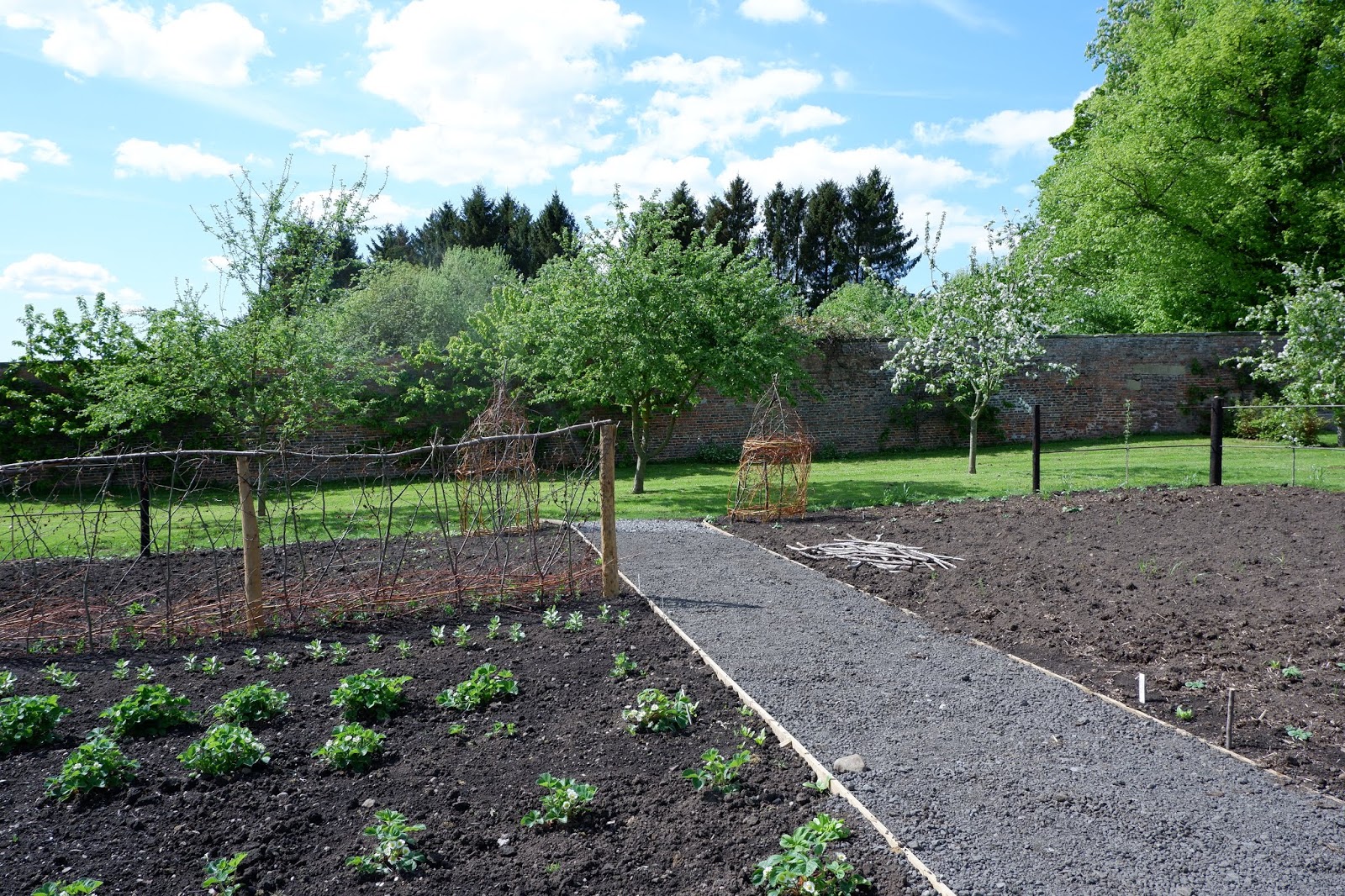
As the final sections of path were filled in with rubble, Giles took delivery of a truck load of road chippings. This would provide the top surface of the paths - another cost-effective yet practical and attractive solution from Giles.

Once again, the trusty old dumper was repeatedly filled and driven to the vegetable garden. The chippings were then shovelled and raked to create a neat, even surface.

The final result was incredibly satisfying. We were all glad to have finished such a physically demanding job, and were now ready to start using the paths to manage the vegetable plots.


The completed path, May 2018


*

Giles still has ideas up his sleeve for the future development of the paths. Not only is a barrel to be sourced and placed in the paths' intersection; next year Giles plans to install cobbles into the path's ends. The cobbles will be a hardy, attractive addition to the paths.

*

Wandering Aengus


The building of the paths coincided with the completion of David's wooden sculpture, 'Wandering Aengus'. Using the massive stump of a (long-dead) Cedrus libani (Cedar of Lebanon), David carved the figure as the gardeners worked away on the paths. It featured in his most recent exhibition 'Finished Unfinished' at his Ripon Gallery. However, as the name of the exhibition suggests, 'Aengus' - who is inspired by the eponymous poem by William Yeats - is still a work in progress... just like the path come to think of it!