Showing posts with label woodland. Show all posts

Saturday, 2 February 2019

Lakeside Logging at Norton Conyers - January 2019


January 31st

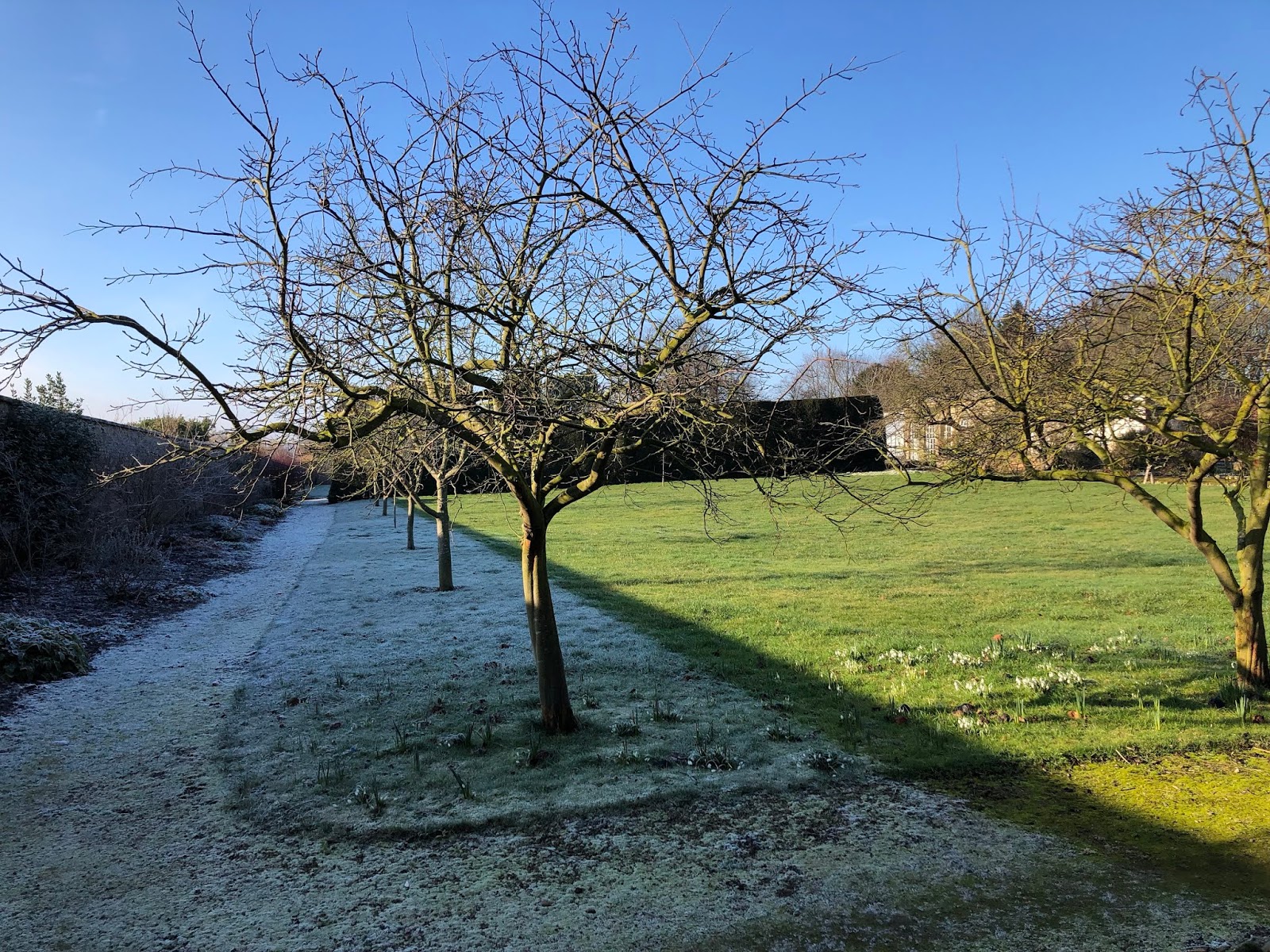
-7.5 Celsius as I passed Nunwick on the way to Norton Conyers. It is the morning of the 31st of January and the coldest night of the season has been endured across the country. The bitter temperatures have bitten throughout much of the month, but the January weather concluded with a numbing vengeance. I walked around the outside of the gardens - senses heightened with the sub-zero temperatures amplifying the eerie silence. Every leaf, twig and blade of grass fixed and fragile in a coarse, crisp shell.

Frosted Garden Gates, 31st January 2019


8.30am
1.15pm


January 3rd

The year had started without frost. Giles and I began 2019 by removing the remainder of the apple tree Malus 'Beauty of Bath' which had been cut down before Christmas. Snowdrops (Galanthus) were beginning to emerge around the tree trunk, and these were lifted before digging up the earth. With axe and chainsaw, thick roots were cut. With rope attached, the tractor was used to pull and twist it out of the earth.

The chainsaw was used once again by Giles and the trunk broken into logs. The earth was replaced - extra compost added and Snowdrops carefully replanted. The job was completed - leaving barely any trace of the 50-year-old tree which once stood. The 'Egremont Russet' planted in close proximity now had space to grow and flourish.

Into the Woods

Next - into the woods. The initial stretch of the pathway was cleared, and habitat piles tidied and consolidated. We then ambled towards the lake, with tools in hand. The area surrounding the lake had been untended for years and it would be a significant undertaking to cut back foliage and retrieve fallen trees from the water. We would spend much of our January days working by the lake.

Starting on the south bank, overhanging branches, brambles and bamboo were cut back, gradually revealing an enhanced view across the lake. I was then employed to cut climbing Ivy (Hedera Helix) on trees to prevent them from being weighed down. I remarked at the woody stalks of the Ivy - some of which were thick enough to be small trees themselves.


Ivy (Hedera Helix)

As we made our way around the lake, we came across a headstone - for a horse. A small pet cemetery also exists in the woodland near the house and - as I later discovered - across the lake.


Luxury
A Chestnut 
Gelding
Died 18th July 1918
Aged 16 Years
A Celebrated Hunter
& Jumper First in the
Kings Cup at Olympia
1907 & 1908
Malise Graham

The Emergence of Life


As the month progressed, subtle glimmers of colour emerged. Most prominently, vibrant strands of lemon and lime sprung from a beautiful Witch Hazel (Hamemelis) to the east of the Orangery. The Hamemelis has a sense of gentle, graceful movement about it - the flowing flowers like the tentacles of a sea anemone. In the dull January light, the Witch Hazel seems to emit its own source of light and bears a delicate scent which belies the season. 


 Witch Hazel (Hamamelis)
But, the reality is that new life is all around us even at the dullest, darkest time of year. Knowing where to look for it is the key. As we walked towards the western garden door, Beth spotted a Hepatica in the undergrowth - it is a small, violet flower of the buttercup family. There is something very special about these small glimmers of fresh colour - a clear display of thriving life and a promise of new life to come.

Hepatica

Lakeside


The lakeside clear-up continued. A Willow (Salix) lay in the water - parts completely submerged and sitting in thick mud. Removing it was a real challenge. Loppers were used to remove branches, before a rope was tied. The tractor was then employed to wrench the tree out of the lake. But there was not enough room for manoeuvre and insufficient leverage; I drove the tractor around the perimeter of the lake and into an adjoining field, stopping behind my previous location.

The tractor wheels slipped and struggled to gain traction as it heaved, and Giles climbed onto the trailer for extra ballast! And after moving onto fresh ground the remainder of the tree emerged from the water. The mud in which it had been buried was very smelly; moving it into habitat piles was an unpleasant business!
Willow (Saxis)


The lake was starting to reveal itself and its true beauty. As the month progressed, bright blue skies created stunning reflections in the water.


In mid-January, Giles cut up a recently felled cherry tree and this was transported to the woodyard using the dumper truck - a huge undertaking, which unfortunately took its toll on the old machine. A section of the bodywork came loose, which required welding. But once Giles had attended to it, the dumper truck continued to fill the woodyard throughout the month, and the last day of January consisted of felling and logging an established Ash tree (Fraxinus).


Hopeful Plum at lunchtime


Hopeful Shandy at lunchtime


Snowdrops


The snowdrops quickly grew and filled out throughout the month - the budding flowers gradually appearing plump and heavy. They are a welcome sight across the estate, adding patches of winter joy to the barren earth.


Snowdrops (Galanthus)


Keepers Cottage


Towards the end of the month, we made our way down the lane to Keepers Cottage. Earlier in the month I had ventured in this direction before starting work; I had seen six herons in one field and four roe deer in another - all at the same time!

Work was needed in the garden of the Keepers Cottage, and foliage needed clearing. Derek, Emma and I had the unenviable task of removing a very hardy Philadelphus (Mock Orange), which was obscuring the view from the kitchen. The Philadelphus grows small bowl-shaped white flowers in the summer, with orange centres. However, when removing this shrub from the earth, it was difficult to imagine that it was capable of growing such delicate flowers. It took a great deal of digging, axing and leveraging to remove the base of it from the ground.


Derek attacking the remains of the Philadelphus
With vast quantities of Ivy removed from brickwork, and last-years growth cut back, we left the Keepers Cottage. Giles and I would return on the next working day to remove an aging conifer and unhealthy plum tree (which was also obstructing a window). Both of these were easily removed with spade and tractor.


Cold Shandy huddling into one of the gardener's lunches to keep warm!!

Ivy


We were all exasperated with Ivy towards the end of the month; cutting it back from walls and trees had kept us occupied for days around the lake and in the wider estate. We spent much time clearing in the woodland to the north of the house and at Wath Lodge which is 3/4 of a mile away. But this is necessary to prevent it from 'taking over' and causing damage.


January


January 2019 - a cold, yet physical and incredibly satisfying month. It was a pleasant surprise to see the subtle beauty in nature at this time of year, but also a delight to enjoy the clean, glimmering frosts and low, rolling mists which provided atmospheric backdrops. However, it was also a month in which I witnessed some of the most dramatic, beautiful skies I have ever seen - a selection of which I now end with.


Saturday, 24 March 2018

Clearing Up - Norton Conyers, 15th March 2018


Another damp day; Spring wasn’t here yet. But the gardener is well prepared - waterproofs and boots were adorned today. We looked a colourful bunch as we left the Orangery this morning and headed to the Dumper shed. And to be honest it was a bit of a dump! It had been left relatively unused at the end of last season, so there was reason for the mess. There's no problem things being left a little untidy, as there are always keener priorities to attend to. So, bearing in mind the poor weather, this was the perfect day for such a job. 

It was a job that required thought as to where to start. There was much to tackle, but with a team of five, progress was soon seen. Giles and I moved wood and logs; the ladies started moving tree protectors to an adjoining building; Plum found a dead pigeon.


There were many tree protectors - maybe a hundred. As I joined the efforts to move them, I uncovered a beautiful Peacock butterfly in hibernation. Its colours were a reminder that nature only sleeps - it does not disappear.


The Dumper shed was full of old unused gardening bits and pieces. Giles is a very resourceful man; he won't throw anything away that might come in useful. However, he's not a hoarder either - everything he does is carefully considered and planned. For example, underneath is a barrel - formerly containing Mango Slices (best before 2000!) from Mumbai in India. It's something that's of value to the gardener - however often it might come into use.

As I cleared some wooden poles from a corner and relocated them, I discovered perhaps fifty ladybirds huddling together - like the butterfly, they had found the perfect, protected spot to spend the winter months. And we had found the perfect spot to spend a rainy day - the work was fulfilling and everyone was in a jovial mood; as we'd entered the Dumper Shed, Giles asked me to switch the light on. There wasn't a light. I'm getting used to this gentle ribbing.


As the ladies finished their clearing work, I stayed and swept the straw covered floor. After Plum found the pigeon, I wondered what else might be discovered amongst this mass of dried grass. I was reminded of an old episode of Midsomer Murders where the victim is stabbed by a pitchfork and covered up in the straw. Thankfully there would be no such discoveries today..

 Following our break, we headed to the stables. Having burned the majority of the rubbish the previous week, the cleanup job now began in earnest. Sweeping the walls and windows of cobwebs; old plaster and paint dust from shelves and window bottoms; the floor from oily dirt. This was a considerable undertaking. The stables had been left in a time-warp - used only as a joiners yard in recent days. It had been built in the 1700s and must have fallen out of use as a stables some 70 or 80 years previously.

I know this because there were old packets on the floor - an old decaying Osram bulb jacket; metal springs; an old car headlamp cover; small wooden signs; a woodwormed groomer's brush. The bench was still solid enough to stand on to do my work, but had seen considerable wear and tear over the years. Built to last. Having lifted it, I uncovered a small plank of wood. It was attached to the stone floor with tar. I lifted it - the perfect shiny black uncovered the still fresh scent of pitch.

Our indoor clearing work was over. We retired to lunch.


As we returned, Giles began cutting back the trees which hung over the road leading up to the stables. Luminous lichen layered long limbs. We dragged the branches over the front of the house; I felt the strain, as an Ox would bearing its Yoke.


Giles, Alyson and I then left the borders of the walls and began cutting back the branches overhanging the Wath road. The Norton Conyers estate covers an area of 1500 acres - another substantial job!

Giles used his extended saw on the branches; Alyson and I hauled the wood over the wall for Beth and Bex to drag to habitat piles. The trees were packed together to begin with; they soon spread out, and there was too much work for three people.


Giles handed me a luminous green jacket, and asked me to look out for traffic; he walked round the other side of the wall and began cutting back from the house side. Lorries and vans seldom made an appearance, but safety was paramount for all concerned.

We completed this work, and next it was back to clear up. However, I got a little sidetracked. The litter by the side of the road was shocking. It upset me that people would dispose of things in this manner. I later spoke to Lady Graham - she told me about how she had challenged a lady who had dropped a takeaway box on the London Underground "I think you've dropped something" she said. The reply verged on abuse - almost physical "I'm providing someone with a job!!". 

I picked up the vast quantities of litter: crisp packets; pair of shoes; glass bottles; a fire extinguisher(!). Lady Graham said that when Sir James and she passed by on their bicycles, they would pick up rubbish - they had only done this the other day. I am coming to realise that the Grahams and I share similar values.

It was a satisfying job I suppose, but one I hoped that I wouldn't have to repeat any time soon!

A satisfying day of clearing had ended - the estate had had a 'Spring Clean' and was sprucing up for its Easter visitors.

Monday, 12 March 2018

Buried Treasure at Norton Conyers?! 8th March 2018

After my alarm goes off on a Monday or Thursday, it’s become a custom for me to check the weather forecast on my iPhone. I only use it as a guideline I suppose - it’s rarely accurate. So after the previous weeks’ weather seemed to indicate winter’s finale, I was surprised to see it was snowing - right now - well, according to the forecast.

I didn’t even give this much thought - not even venturing to open my curtains. There might be some sleet in the air - perhaps a little flurry of actual snow. But last week was a freak March weather phenomenon… wasn’t it?!

I’d forgotten about the forecast when - after getting ready - I stepped into the lounge to see the monotone veil outside.

I ventured out well prepared. I’d baked a 'Torta di Nada' - a Jamie O blueberry and olive oil cake the previous day to sustain us gardeners. I hoped it would be a match for Bex’s clementine cake…

The snow fell - thick and rapid yet silent. A thin layer on the road. The car well covered and icy. I put my bags in the boot - the car interior dark like a windowless room.

The windows were scraped. De-icer sprayed. Engine on. Heating on full. I gingerly engaged the clutch. I would turn back if necessary, but the forecast - although not to be trusted - indicated a wet, mild afternoon.

The side streets were slippery; leaving Harrogate slow.

The sliver of snow belied the treacherous conditions. A windy, hilly road. Rarely over third gear. 

The conditions worsened - a grey blanket surrounded my car. I turned into the Wath road into almost virgin snow; the car gently slid despite the slow speed. 

Here was the challenge. The narrow road winds and weaves. Blind corners and undulations. I meandered - barely over 20. 

Relieved to have arrived, I turned into Norton Conyers, making fresh tracks and I looked forward to seeing the gardens under a blanket of snow for the first time.

I was early again, so wondered out towards the house with boots crunching underfoot.

The atmosphere was still and quiet - the soft, persistent fall of white a faint whisper through the air.


Giles, Plum and I strode through the gardens, making our mark on the perfect, untouched covering. Alison soon arrived, but after a conversation with Giles - there wouldn't be much to do today - left. The other girls had already called to say they wouldn't be coming due to the weather.

Today was a job outside the gardens. We grabbed spades and forks and ventured towards the house.

Pollarded Willows in the Snow
An outside wall of a building adjacent to the house had a damp problem. Giles had been advised by an architect to dig a trench alongside the outside of the wall in an effort to expose any problem. The trench could then be filled with stones to improve drainage.


This side area brought the house's outer buildings to the edge of the woods; unmanaged and a little overgrown, but scattered with snowdrops and perfectly natural. The weathered ancient wall told its own story of change - blocked up windows and doors - newer brick amongst the old stone.


The digging began - Giles and I spread along the wall. But we were to dig with care; Giles explained that parts of the house were Anglo-Saxon, so buried treasure might be lurking beneath!!

The unrelenting snow continued to fall, but I was hot before long. The earth lifted easily, blackening the white earth as it was deposited, and progress was rapid.

I noticed how effortless Giles made it look. I felt to be wasting a lot of energy; my technique would need adjustment!

It wasn't long before my spade hit pottery, glass and metal, and the harder work would begin. There was nothing of value - they were the bones of the building's previous fittings. 

Long sections of metal guttering came up as worms wriggled their way free. The first drain seemed a little blocked - we would come back to it later. 

In the space of a couple of metres, hundreds of pieces of glass lay on and under the surface. I looked up; as I expected, a window sat directly above this spot. A broken plant pot served as a receptacle; Plum didn't want a poorly paw! She was cheerful, keeping herself busy as she snuffled through the snow. She seemed to have grown a white beard as she looked up at me. Her sister was in the van - just happy to have been brought along!

I unveiled an old rake head; a guttering bracket; terracotta piping.

We were nearly half way, and it was time for tea. The snow had slowed. My jacket was saturated at this point, my sleeves wet and filthy. We left a muddy trail in the snow as we marched in front of the house, back to the Orangery.

I filled the kettle using the outside tap, and cut the cake (which was fit for 6 people!) 'Are you hungry, Giles?' I asked. 
I greedily ate my ample portion and warmed my hands on my tea. The snow had stopped.

Giles received a call from the builder shortly before we were due to recommence our work. He would be here in a minute to discuss work on the orangery with Giles. 

We waited for him, and Giles took the opportunity to show me the peach trees. They had been planted in around 2008, after the previous trees (planted in the 1940s) grew tired and ragged. They were neatly trained. Giles explained how prolific they were. It is important to quickly take remove weaker fruits to promote healthier, bigger crops. The lesser number of fruits wasn't an issue for Giles: 'After all, you soon tire of peaches'! At this moment, an avalanche of snow fell from the sloped orangery roof. Plum jumped - to coin a phrase, she was all peaches and plums (!)
Giles continued to tell me about the peach trees and pest management, and he was interrupted as the builder entered. At this, Plum found her voice.

I left Giles to continue his discussions and cracked on with the digging. There was no need for waterproofs now, and I quickly warmed up again.

It was a struggle to get back to work - too much cake - but I plugged away. My arms jarred as I brought the spade down. I uncovered a huge section of terracotta piping; a little further along was the next drain. Here, the earth quickly became sloppy and boggy; it seemed I had discovered one source of the damp.

A pygmy shrew darted into the trench, seemingly towards the dead end of the drain. But it climbed out effortlessly, and scarpered towards the snowdrops. And it disappeared, as quickly as it had arrived.

Giles returned, catching me catching my breath. 'You're not finished yet are you?!' he joked. I laughed. 'Where's Plum?' I asked him. 'Talking to Shandy' he replied. I laughed again.

Wooden frames, a pitchfork head, metal guttering, more broken glass... but no treasure.

I heard Giles let out a shocked grunt, and I turned from my work - his spade had plunged deep into the earth. He had come across a rabbit hole!

We continued to work. I was 'entrenched' in my work, so didn't notice when Giles left. He returned with a wooden pallet, which he proceeded to lean it against the wall. He climbed to an upper shuttered window to find out the level of the floor.

This prompted him to tell me of a ghostly encounter. He had been working in this area at Norton around 20 years ago when he heard footsteps above him - clear as day. There was noone around. No explanation was to be found. One of his colleagues heard the steps - the other did not. 

This reminded me of the incredibly convincing ghost story at the Treasurers House in York, where plumber Harry Martindale saw a Roman army unit march past him in the cellar. He confounded historians by describing their attire - it did not match historical records. However, years later, a discovery was made that showed Harry's description to absolutely match the uniform of a specific rank. I paid no attention to ghost stories until I heard that story. I have no real superstitions, but perhaps there is something about buildings of this age? Who can account for what Giles heard or Harry saw?

The Yew trees (Taxus Baccarta) rained their melting snow on us. The sky had cleared and the sun shone. The snow would quickly disappear.

Another builder appeared as we finished the trench. 'I thought I was hearing things.' he said. 'Well I've heard things here before.' replied Giles, before repeating the story he'd told me. They talked about the damp wall and the potential causes we had discovered. He was doing some work inside and had lots of plaster to dispose of.

I left them to discuss the work, and began tidying up. We would return with a digger to clear the earth at a later date.

Lifting the lid on a blocked drain!
As I crossed in front of the house, the view revealed itself - further than I had ever seen from this point. It was clear - the sky a pastel blue and patched with radiant clouds. This beat being in an office.

We took a wheelbarrow each - I cleared foliage to the rear of the orangery (they had been cleared by the builder, who had been assessing work needed on the wooden boards behind the guttering), whilst Giles returned to gather the metal. He collected this to take to a scrapyard.

We ended the day early - it would still be a while before the snow melted sufficiently to allow worthy work to continue. I gave Giles the rest of the cake 'I hope Mrs G likes it!'. He was grateful. 'Where did you get it?' he smiled in his comic deadpan - something I would get used to regularly experiencing.

Giles thanked me for coming in 'It wouldn't have been much fun digging that on my own.' he remarked. I removed my windscreen protector (which was redundant now the snow had melted), and took off my soaked boots.

The completed trench!


The road leading to the A61 had lakes across it - a stark contrast to the morning. As my car rolled through, the water gushed up to the top of the windows, the muddy water mocking my decision to wash the car the previous day...

It was bright and cheery; I got the sense that this Spring weather wasn't a repeat of last week's false start.


Wednesday, 28 February 2018

Bordering at Norton Conyers, 22nd February 2018

Bordering at Norton Conyers, 22nd February 2018


The weather forecast has rarely been a matter of concern for me. Being British it’s an expected topic of conversation, but today I had reason to check the forecast. Cloudy but DRY! After Monday’s damp gardening initiation, I looked forward to more pleasant working conditions. 

It proved to be a chilly and slightly misty start; this atmosphere beautifully complements the historic setting and intrigue of Norton Conyers. The environment is beautiful in itself, but the mist gives an additional veiled layer which seems to resonate through the ages; I felt a connection with Charlotte Bronte and understood how she would have taken inspiration from this place in her writing - not just in Jane Eyre . 

The equipment required today - wheelbarrows, buckets, spades, forks. The three wheelbarrows available were of different ages and materials, and each with its own character. Although battered and rusty, with a few holes the eldest of the wheelbarrows remained sturdy and reliable - like an old friend. But all three would be well used today.

One of the two main borders was to be tackled today. I was struck immediately, not only by Giles’ plant knowledge, but his ability to recognise a species from its root or surface growth. He uses the Latin names too! It became apparent that there was a lot for me to learn here.

Plum, Giles' Dog
I realised at this point that I had not seen Sandy and Plum since I parked my car. Giles said he’d seen them attempting to manage the rat population! Sure enough, distant barking would be heard for much of the morning.
Whiteroot (Gouania lupuloides) and Bindweed (Convolvulus) were the main enemies today. A pile was created for any roots or plantmatter of these species to ensure segregation and appropriate  disposal.
Gate to the Woodlands
Managing this border required the removal - not only of weeds - but of healthy plants too. Acanthus and Thermopsis were among the many species that required cutting back - or removal altogether - to stop them ‘taking over’ or overwhelming the border. 

Working close to the earth is a sensual experience - picking up on the subtle scents of roots, wood and the freshness of the earth. 

The day involved regular trips to the woods to dispose of barrow-loads of organic material. It is striking to witness the resourcefulness of the gardener - almost all waste has a good use: hazel twigs for plant supports; woody roots and weeds placed in rabbit holes; woody stems creating habitats for insects; other organic matter being recycled in the garden via the compost heap. Indeed, huge quantities of compost were reinvested into the garden today, with Giles’ dumper twice replenishing our stocks.
Another heavy, yet satisfying day drew to an end; sunshine brought a taste of the coming spring. We had enjoyed perfect gardening conditions - cool, crisp and dry - not too bright. It was striking to see how turning over the earth had breathed fresh life into the borders. I will watch its development over the coming months with growing interest.
Snowdrops (Galanthus) in the Woodland Outside the Walled Gardens