Monday, 28 May 2018

Up the Garden Paths, Norton Conyers, Spring 2018

Up the Garden Paths, Norton Conyers, Spring 2018


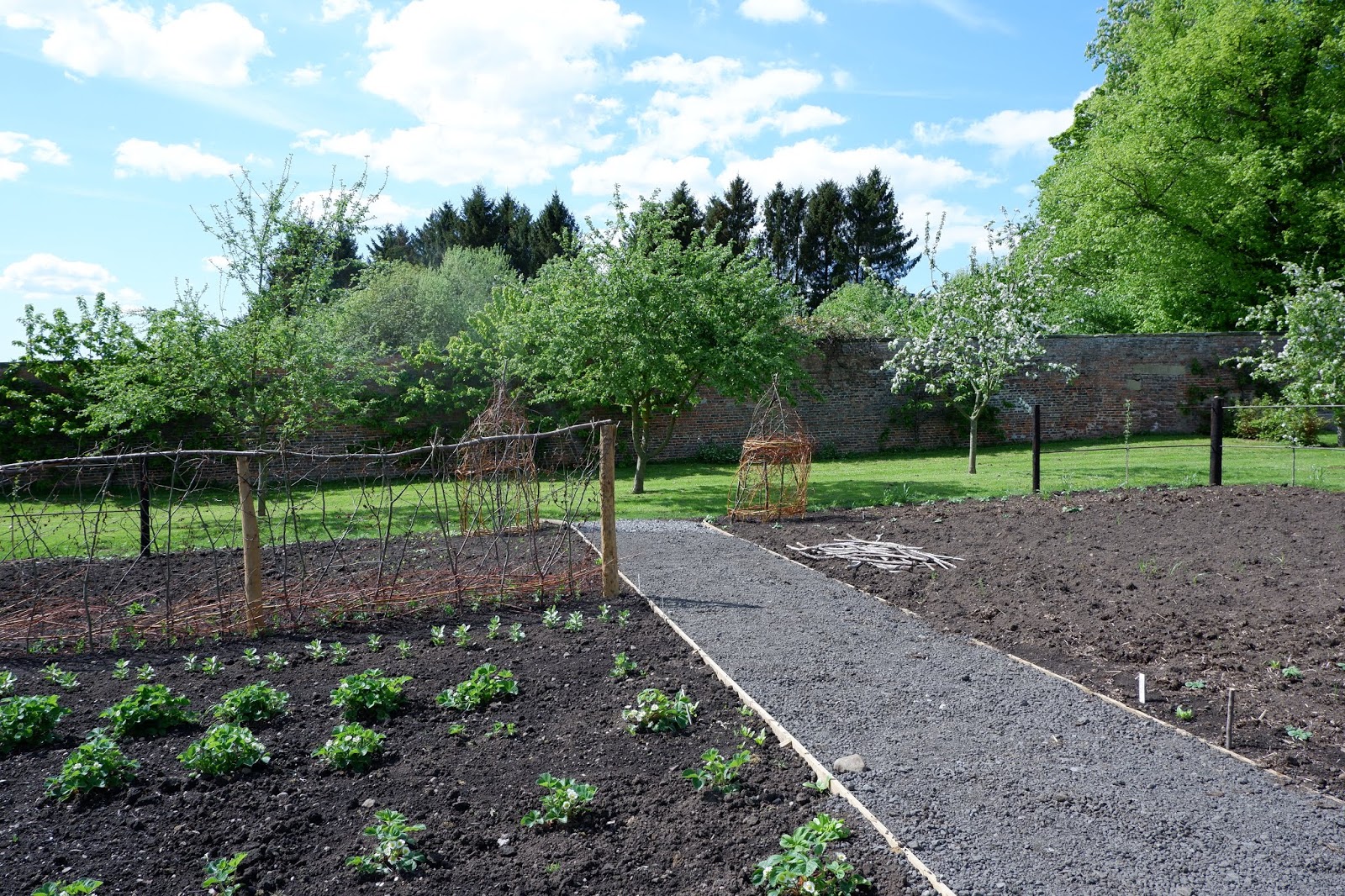
I write this a few weeks after the completion of the paths which now stretch across the vegetable garden. It is the most significant structural change that has taken place at Norton Conyers since I began my gardening career in February.

As 'ground was broken' on the new paths in late March, I was quite naive to the processes and efforts that would be involved. 

After the Easter weekend, Giles, Alan and I ventured over to the vegetable path with spades in hand. Work had already started the previous week when I had been allocated work elsewhere - some planks had already been installed, meaning that some boundaries were already in place. Giles gave us our instructions; and so the digging commenced. The good news for us was that the earth did not need transporting. Instead, it could be shovelled to the side; it was required to raise the level of the lower end of the vegetable garden. 


Beginnings

The vegetable patch is on a slope. It was therefore difficult to judge a 'true' level. Much of the work was done by eye initially and finished off with the aid of a spirit level; optical illusions were created because of the slope, and it was therefore difficult to work without a more scientific aid. 

Alan and I worked hard, and soon looked forward to our tea break. Despite this, Alan commented that he was surprised by the soft consistency of the earth - it was of a relatively even texture, and there were few stones to get in the way of our spades. 'I suppose we have three hundred years of cultivation to thank for that!' Our work was easier than it might otherwise have been.


Peach Blossom
Digging took up much of the day, and a 'path' of sorts started to come into being. 


Alan installing a stake
When the ground was cleared of earth, and levelling finished, we started on a new section. Giles joined us to install the planks. A garden line was used, and the planks were put into place on the perimeters. A pole was used to 'start off' the holes for the wooden stakes, and a sledgehammer to drive them into the earth. And the planks were then nailed into the stakes. This process was repeated at even intervals, and before long the structure of the path was in place. I think I risk making this sound like an easy task; the reality was an extremely painstaking process, with precise measurements required. Even a slight bowing of the wood could lead to a bigger (and more visible) problem further down the line. This required checks and alterations to be made at every stage of the process.

Bex joined us in the afternoon to help out; as did Shandy and Plum. Shandy took particular delight in laying down on the pile of wooden stakes.


To finish off this part of the process, the ends of the path were curved by Giles; planks were partially sawn into at intervals to enable the planks to be bent.

This whole process was to be repeated for another two working days.


Completed Path Boundaries


*

Filling In


And so, the earth was cleared; now we needed to fill it in! This required rubble. As I have previously described, Giles is an extremely resourceful man; if he can avoid spending money, he will. Beth and Bex brought rubble from building projects at home - this was a great start. 

Much unused concrete lay in the area adjacent to the courtyard. Old pig troughs needed breaking up; I was employed to do this with a sledgehammer - a very tough job which required patience and determination in equal measure. It also required intermittent breaks; Giles had just the idea for my 'breaks' - shovelling manure!!


Alan had previously borrowed a jackhammer from Giles to clear the concrete patio in front of his house. Alan and I set out in Giles' van to pick up the rubble; we filled the van twice. On each occasion, the dumper waited for us to fill it in the courtyard. The rubble was then spread along the paths, and - if necessary - broken up even further. This process was repeated many times with rubble from other sources - including Giles' own home.


The laden dumper


*


Dahlias

I must have shown my growing weariness, as - a few weeks into the path building - Giles asked me to help with the planting of dahlias; this proved to be a welcome change after weeks of digging and hammering, and it was good to do some actual gardening! The dahlias had been brought into the orangery over winter; now was the time to break them up, repot and label them. I was surprised by the sheer number of different varieties.


Potted Dahlias


*

The top path in the vegetable garden hadn't been filled by this point; in the afternoon Giles asked me to dig a trench in order for the tap (which was installed on my first day in the gardens) to be relocated into the middle of the garden; Giles plans to install a barrel here to make an attractive centrepiece. As the trench was dug, the clouds gathered. And the rain drove down. Upon finishing the trench, Giles helped me to lay the rest of the piping and move the tap into place. We finished the day soggy and sodden.


*

As the final sections of path were filled in with rubble, Giles took delivery of a truck load of road chippings. This would provide the top surface of the paths - another cost-effective yet practical and attractive solution from Giles.

Once again, the trusty old dumper was repeatedly filled and driven to the vegetable garden. The chippings were then shovelled and raked to create a neat, even surface.

The final result was incredibly satisfying. We were all glad to have finished such a physically demanding job, and were now ready to start using the paths to manage the vegetable plots.


The completed path, May 2018


*

Giles still has ideas up his sleeve for the future development of the paths. Not only is a barrel to be sourced and placed in the paths' intersection; next year Giles plans to install cobbles into the path's ends. The cobbles will be a hardy, attractive addition to the paths.

*

Wandering Aengus


The building of the paths coincided with the completion of David's wooden sculpture, 'Wandering Aengus'. Using the massive stump of a (long-dead) Cedrus libani (Cedar of Lebanon), David carved the figure as the gardeners worked away on the paths. It featured in his most recent exhibition 'Finished Unfinished' at his Ripon Gallery. However, as the name of the exhibition suggests, 'Aengus' - who is inspired by the eponymous poem by William Yeats - is still a work in progress... just like the path come to think of it!


Tuesday, 8 May 2018

April Miracles - Norton Conyers, April 2018

April Miracles - Norton Conyers, April 2018


The gap between this post and the last wasn’t intentional. Sorry if anyone(!) has been waiting for the next instalment. I’m glad to report that this post will give you a good summary of the intervening weeks and bring us up to date. 
However, I also think it’s quite appropriate. The last month has seen the biggest transformation I have seen in the gardens, and surely the biggest transformation of the year.

April brought the full British spectrum of weather - we had snow, rain, a heatwave; indeed it was like a year unto itself.


Perhaps this weather was the ‘perfect mix’ for healthy Spring growth; as I write, the gardens are flourishing, and growth has been incredibly rapid. 

Peach Blossom
The lawns are now being mowed once a week, and visitors are appearing regularly.
So, the weather and the flora have both undergone almost miraculous transformations. But the biggest achievement for the workers at Norton Conyers this month was the transformation of the physical space in the vegetable garden. Giles had a masterplan for new paths to be installed in this space. He isn’t one for sharing his plans however, and keeps us on our toes!!
In late March, Giles ventured off in his van, and returned with huge planks of wood and stakes. I was fairly tired, having turned manure grass for much of the day, but Giles and I shared the job of hauling them from the middle garden gate to the vegetable garden. We laid them at intervals. Perhaps I wasn’t listening properly, but I vaguely remember Giles saying something about path building at this point; up until then I thought we would be creating borders…
A series of blogs are on the way detailing the building of these paths, which, all being well could still be here in a century or so. One thing Giles is certain of - no one will ever move the foundations we laid!!

Easter in Edinburgh

The end of March also saw my first break from the gardens; the last Tuesday I ventured up to Edinburgh, and the gardens allowed us a day off for Easter Monday!
I didn’t get away from gardening, however. We stayed with my Aunty in Burntisland, and relaid a huge section of turf in her back garden; this needed doing due to a trampoline installed by previous owners which had ruined the grass! Being in the area, I had obligatory Whiskies and explored the wonderful city of Edinburgh. However, The Royal Botanical Gardens were new to me, and I was truly blown away. Both the scale and magnificence of the gardens were worth the Harrogate to Edinburgh journey alone. Perhaps it was the Spring air? The grandeur of the plants in the glass house? Well perhaps it was a mixture of both of these, but it was undoubtedly the dedication and careful conservation of thoughtful, inspired and forward-thinking gardeners and architects. The gardens deserve a post of their own; watch this space!
The Victorian Glass House at The Royal Botanic Gardens in Edinburgh

Rallying Shandy


Shandy had been a bit off-colour a few times over the last few months; who could blame her after the miserable winter we’ve had in the UK? But April saw the 15-year-old rallying and youthful once again. Plum had been left to her own resources on a few occasions this year, but now her mentor returned refreshed and ready to show her how it’s done. The rabbits of Norton Conyers shuddered.
Shandy and Plum having a (well-earned!) break from catching rabbits
Markenfield Hall

Towards the end of March, Giles recruited me for a day at Markenfield Hall - another blog here too!! Both Norton Conyers and Markenfield both have a unique, enchanting and historic beauty, unspoiled by hoards of visitors. Markenfield Hall is a 14th Century manor house 3 miles south of Ripon. It has been wonderfully conserved, preserved and restored. Even more remote than Norton Conyers, Markenfield really is off the beaten track - it is a little paradise of its own. The surrounding moat adds to its unique charm.
Mowing at Markenfield
Mowing and Hoeing

Having laboured hard on the paths for much of April, Giles gave me a break and sent me to pot up the Dahlias with Bex and Alyson. Having sledgehammered, lifted, hammered and dug my way through April, I was glad for a change. ‘Don’t get used to it, though!’ were Giles droll words as he left us to get on with it! Giles is never short of wit.
Dahliutopia

The Dahlias don’t survive the winter; they were dug up from the borders in November and stored in racking in the Orangery. Alyson operated the computer to write and print off labels for the different varieties, and we all worked as a team to break up the tubers, before potting them in fresh compost. This was a full day’s work!
Grass cutting and hoeing finished off April at Norton Conyers (both nearly finished me off!). I still haven’t progressed to the level of ‘sit on mower operator yet’, so my job involved mowing the edges and smaller areas. A big job! Despite the recommended 10,000 steps, the stepcount recorded by my iPhone reached 33,000 after a full day mowing the lawn!


Green Fingers
‘I find hoeing quite therapeutic’, remarked Giles as he passed me in the circular border near the entrance to the walled garden. I agreed - but later would revise this - ‘to an extent!!’

April was the most varied and satisfying yet, but I have a feeling there are even better things to come in these remarkable gardens.


Tuesday, 27 March 2018

Supporting Norton Conyers!! 27th March 2018


A glorious start. Today's weather brought out the very best in the gardens. It was milder too. Despite it starting off dry, the weather is fickle, so I had still come fully prepared for the worst. In the event, this wasn't needed, and I could soon take off a few layers.

It was the perfect day to bring the benches out of their winter rest - having treated them with linseed oil a fortnight ago. Alyson and I manoeuvred the benches out of the Bothy and lifted them to their appropriate places in the garden. Benches are awkward things to carry - your legs keep getting in the way, meaning you can only make small - but quick - steps. It must be quite comical to watch thinking about it.


Benches bring something unique to a garden. I can't quite place it but perhaps it is the human spirit - the reminder that others have been here before you and enjoyed this very same view.

The benches looked superb in situ and felt soft to the touch. But there wasn't time to sit around; one more bench lay ready to treat - once again, Alyson and I used rags to do so.

My next task was back in the vegetable garden, continuing the task I had started on Thursday. Bex had already used the strimmer to cut back the Manure grass. This made for easier work - upturning these plants, and returning them back in the earth.

Having used a spade the previous day - I thought a fork might be easier. It was. My progress on the patch was quick. Giles soon joined me to lend a hand - he dug with a spade. He said that although it's easier to turn over the earth with a fork, the spade delivers better results. Giles got me a spade from his van and we returned to work.


I had baked a cake for us hard-working gardeners - Jamie Oliver's Torta Di Nada - a blueberry and olive oil cake previously mentioned in my blog. It went down a treat - a moreish, moist and fruity recipe, which gave us all a boost of energy.


We returned to work, and Plum promptly arrived rather proudly with a dead rabbit. It hung limp and lifeless in her mouth as she chewed - its eyes misted and matt black. Giles was happy for her to eat it if she wanted, but wanted to get the tail for the purpose of pollinating first. However, Plum wouldn't give up her catch - she frolicked with it as her Dad made a vain attempt to catch her.


I finished off my stretch of Manure grass, and Giles asked if I wanted a change. My back was starting to feel the strain, so I was glad to be offered this.

I joined Alyson in building and restoring pea supports. Some of the current supports had come loose in the earth - others were broken or no longer fit for purpose. These arched supports are a thing of beauty in themselves when finished - offering  shape and structure to the garden in the absence of plant growth and also shape to the growth when it comes. The knife on my multi-purpose tool came in handy for this task. However, I nicked my finger on it as I cut the twine - there are bloodstains on the branches to prove it!


We retired to lunch. I had saved half of the cake for Sir and Lady Graham, so walked to the house to deliver it. The daffodils had opened up, and looked glorious in the backdrop of the Spring sun and sky.

I finished off my supports, before joining Alyson again on the main border. A support was needed to straddle two neighbouring Heliopsis plants. The support would need to be tall and strong. The earth was tough, and I plunged the branches in vain. Alyson suggested I use a fork to break up the earth. This was just one of the many useful tips and hints she proffered throughout the day; like Giles, Alyson is also a fountain of gardening knowledge, and believes in doing things properly.


At this point, Giles arrived and asked me for my help. I followed him to the area outside the Dumper shed where a huge van stood, bearing the moniker East Riding Horticulture. This was our compost delivery; clearing out the shed the previous week had been very useful, giving up a clean, empty space in which to store it.
The bags were heavy - 75 litres - and there were lots of them - 40 to be precise! Fertiliser, gravel and plastic sheeting completed the delivery.


I returned to finish off the supports - it took a lot longer than I was expecting, but I was pleased with the result.


Resident artist David Stead had hosted a group of ladies for an art class today, and was showing them the gardens. They commented on the beauty of the supports we had created - it was pleasing to have this appreciation.


During all this time, Alan, Bex and Beth had been busy in the vegetable garden - starting to build raised beds. Haven't seen the results yet, but as I'm on holiday now for the next week, it's likely things will have changed quite dramatically again by next Thursday!

As I tidied up, Giles and David ventured into the gardens, and I was called upon for assistance. David had acquired a huge tree stump - Cedar of Lebanon (Cedrus libani). It needed lifting upright. Giles used his mini tractor to lift it up; David used a metal stake in the ground to prevent it from toppling; I looked on - ensuring the stump wasn't in danger of slipping. The stump was now upright, but not stable. We tied it to the concrete slabs in the yard using blue rope.


I ended my day - again tired but strangely refreshed. I looked forward to the fresh challenges I would face the following week.


Sunday, 25 March 2018

Digging for Norton! Norton Conyers, 22nd March 2018


Spring has seen more than its fair share of false starts this year. I suppose it usually does, but then this year, there have been several heavy snow showers - interjected by mild sunshine - in March!! However, as I drove up to Norton Conyers today, I recognised a difference in the tone of the sky that suggested that this was Spring sunshine. Blue skies in winter tend to be slightly paler and cloudless, and the light offered by the Spring sky is unmistakable.

As we greeted each other this morning, the mood was cheerful and relaxed - all of us commenting on the lovely weather, and what a difference it would make to the day's work. It is true: good, mild weather is liberating for the gardener. Less layers to worry about; your whole body is more relaxed; there is no dread - or danger - of getting soaked to the skin before you've done half an hours' work.


Wheelbarrows, spades and forks were needed for our first task. Alyson and I hauled multiple full barrows of compost from the heap, and spread it generously over a huge, empty border. We had soon emptied the compost bin; quite a feat, having seen the quantity in the pile at the start of the day!

As she plunged her spade into the compacted earth, Alyson told me of the toads that had made the compost heap their habitat in years gone by. There were none today though!

The improved weather was good news for the garden's flora; the warmth had brought a few bees out of their slumber. We had been planning to aid the pollination process the previous week, but in the absence of a suitable brush hadn't been able to do so. Giles commented "Perhaps we won't have to use Shandy's tail after all!" Nevertheless, he thought the bees would still need some help, so in the afternoon volunteer Sue borrowed a brush from resident artist David and went about pollinating the peach stamens.


Next, Alyson and I dug up shrubs in the adjoining bed. They had spread, leaving the middle of the plants dead. Splitting the plants would rejuvenate them, and help them to thrive. A layer of compost was turned into the earth, before replanting. We then weaved supports - like inverted baskets. They were very attractive in their own right.


The afternoon: more digging. In the vegetable patch, 'Green Manure' had been planted to act as a natural fertiliser; in order for it to do this, the row had to be dug up. I began to tire - the cumulative physical effort was beginning taking its toll on my back. However, I finished the job, turning over the plants and digging them back in.


Giles had ventured out to collect timber planks earlier on in the day. Transporting these across the garden was the penultimate physical effort of the day. Giles and I carried them - around 30 - from the middle garden gate to the vegetable garden. We placed them approximately where they would be finally installed for the raised beds.

I finished the day digging up exhausted lettuce plants; the massive roots were heavy. I wheeled them over to the compost heap, and the cycle of decay and growth continued.


Although I felt physically exhausted, the mental effect was invigorating. This had been another extremely productive day, and we had all worked very hard to make this substantial progress.